
Another five? Man alive!
Let’s get into it.
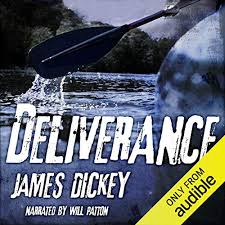
Deliverance by James Dickey (reread).
My rating: four stars.
I last read Dickey’s novel decades ago, and had forgotten pretty much everything about it. Rereading it recently reminded me that what I thought I knew of the story was much more influenced by the movie – and the cultural shadow of the movie – than by the text itself .
When I hear the title of the novel, thoughts inevitably turn to the “squeal like a pig” or “you got a purty mouth” lines because they’re so indelibly linked. Neither of them appear in the novel, because they’re the product of John Boorman’s unflinchingly uncomfortable portrayal of mountain men gone wild. What does appear in the novel is much more thoughtful than I had remembered.
After four hours I passed slowly from the country of ‘nine-fingered people and prepare to meet thy God’ into the drive-ins and motels and Homes of the Whopper but all I could see was the river.
The novel is the story of some Georgia citydwellers who plan a trip by canoe down a river in an area destined to be flooded for a hydroelectric dam. It’s told in first person by a graphic designer, Ed, and it’s very much an exemplar of the guys talk about shit book: lots of observation and carping about all manner of shit including work, hobbies, and what they’d do If The Shit Came Down.
More of the novel than I had expected is taken up with setting the scene of the characters’ lives. They’re looking for some kind of deliverance from their routine lives, while by the novel’s end they’re looking for deliverance from the horrific shit that’s gone on far from society. There’s a strong sense that before their trip, these characters wanting to be tested, wanting to show they can measure up to the requirements should they be called upon, and the tension spins out of whether they can.
It put me in mind of the beginning of Eugene S. Robinson’s book FIGHT: Everything You Ever Wanted To Know About Ass-Kicking But Were Afraid You’d Get Your Ass Kicked For Asking:
And the scenario is repeated again and again. It wheedles its way into boardrooms and bedrooms, this not so particularly male obsession with the eternal, unasked “Can I take him?” Which could be extended to “Can I take it?” Or better yet, “Can I?” With all apologies due to Sammy Davis Jr. (also a student, despite his diminutive frame, of the fistic arts), the answer is always the same: “Yes I can.” Even when you can’t.
Can they? Well, I suppose that depends on your interpretation of the question.
After I’d finished reading the novel again, I teed up the movie for another viewing. Again, it had been quite some time – Burt Reynolds was still alive and Jon Voight hadn’t gone mask-off fuckhead at that point – and I was struck at how remarkable this film is. (Voight’s terrible “I’m drunk!” acting notwithstanding.) It shows tough guys in moments of weakness, is incredibly shot, and features Dick Jones before he got into OCP, which means there’s something for everyone in here.
The Pretender by Jo Harkin.
My rating: five stars.
WELL NOW.
The Pretender is the story (a true story, no less) of 1480s England and the attempt to install a pretender to the throne. It’s the story of a small boy (initially called John, but he ends up with a brace of names) who discovers that he’s meant to be the next in line (so he’s told, anyway) and has to leave his country life to… perhaps die in battle or perhaps become a king?
Also, he hates a goat.
John tries to imagine being a boy king. His first act: the beheading of Gaspard, for divers villainous buttings-over – and no sign of repentance. Those uncanny slotted eyes say: God is not my master. Gaspard’s death would be a warning to all goats, and all the little children of England would cheer King John, safe from treadings-on and tramplings evermo.
The narrative excellently captures the confusion of a kid who’s suddenly in the middle of political horse-trading and fuckery. He’s thrust from a farm into the world of lickspittles and grasping opportunism, when all he really wants is to be able to read a bit of Chaucer, and maybe feel a boob.
‘Have you been in a battle?’ Edward asks him. ‘Of course,’ Thomas says. ‘Sure there’s always a battle on around here. Lots of kings. Lots of mortal enemies. Every fucker wants every other fucker’s castle.’
I’m not going to go any deeper into the story, but I absolutely loved this. It’s funny, it’s historical, it’s detailed and there’s enough moral ambiguity that I couldn’t hold hard on a reading of a character the whole way through: everything was up for grabs in a manner that reflected the tumult of those years. Strongly recommended, particularly if royal machination and English history is your thing.
Babylon’s Ashes by James S. A. Corey.
My rating: three stars.
This is the sixth novel in the Expanse series that I’ve read, and it’s probably the one I enjoyed least. I suspect this is because it feels like this is the part of a pre-planned narrative arc where a lot of pieces need to be put into place to enable the next lot of Cool Sci-Fi Shit to occur.
That doesn’t mean this is a bad novel. It’s enjoyable, and features some great moments from old favourites (and less examined characters). It’s just that some of the beats in here felt forced or a bit cheap, and chucked in to enable the whole show to move to another point of conflict.
Silence filled the deck. “You notice how she didn’t say anything obscene or offensive?” Holden said. “Did notice that.” Holden took a deep breath. “That can’t be good.”
This is largely a novel about politics and group dynamics. It examines whether a rebellious force can hold itself together if the leader is a dick, whether politicking can actually save the world, and what the fuck people should do about holes in space that eat ships. There’s a lot of back-and-forth manoeuvring rather than back-and-forth pew-pew. Sure, the previous instalment set a lot of things in motion that require time to play out… but this feels a lot less kinetic (and interesting) as a result .
I’m not the boss of anything, but seems to me like having Babs here and not putting her in the front line? You use a welding rig to weld things. You use a gun to shoot things. You use a Bobbie Draper to fuck a bunch of bad guys permanently up.”
TLDR? Those guys write space battles like a motherfucker but a pausing-to-set-up-the-next-bit novel is a pausing-to-set-up-the-next-bit novel no matter how much sweary bone snapping you put into it.
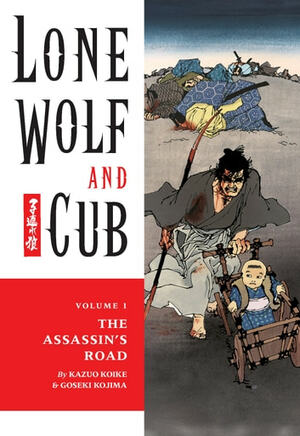
Lone Wolf and Cub Volume 1: The Assassin’s Road by Kazuo Koike & Goseki Kojima.
My rating: five stars.
So hey! This is a venerable icon of manga (and film, but I’m going to hold off on watching any of those until I’ve finished all these books) that I’ve been sleeping on for decades, it seems.
The series tells the story of executioner turned assassin, Ogami Ittō, and his son Daigorō. The pair wander the land, taking on jobs and generally being heroically bad-ass yet principled.
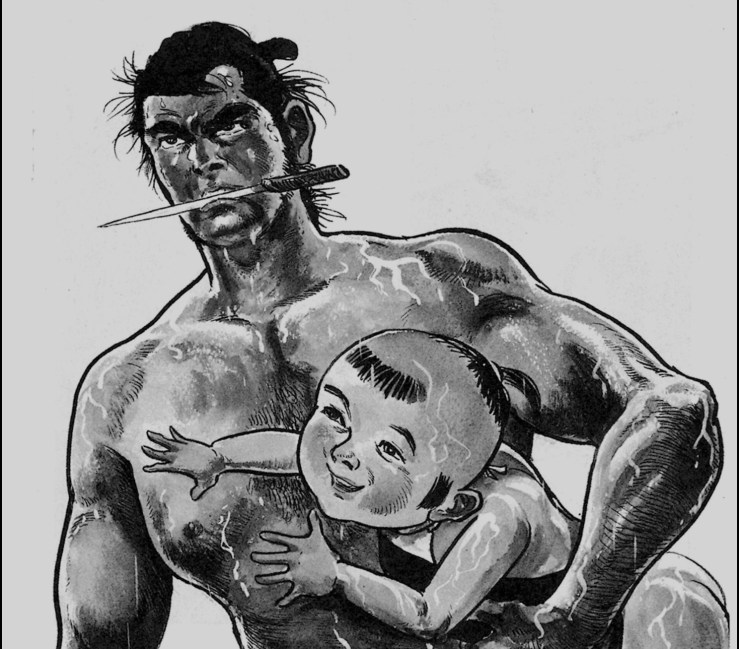
This volume – the first of 30-odd – has a cover by Frank Miller (eh) and engrossing Goseki Kojima artwork that appears to have influenced, oh, I dunno, everything.
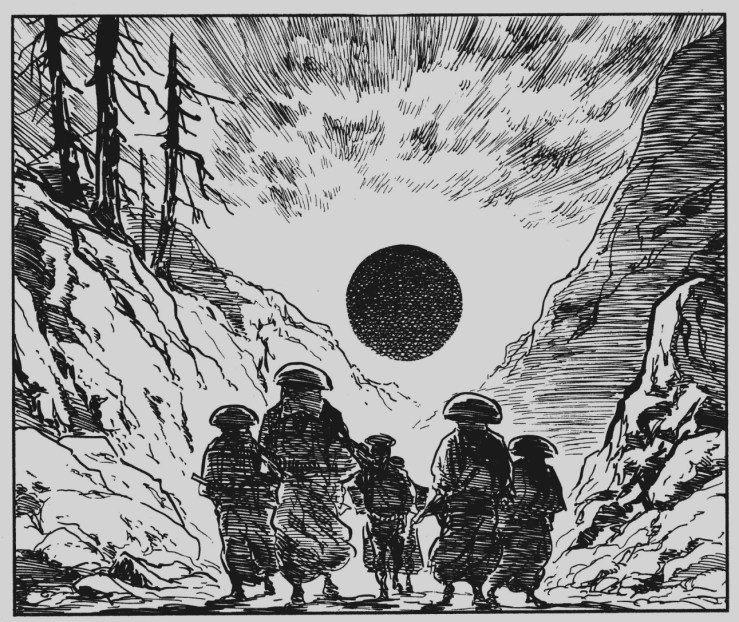
There’s such a direct, propulsive nature to the art. It’s both widescreen and close-up, full of action and meaning (hello, speed lines!) that drives everything forward.
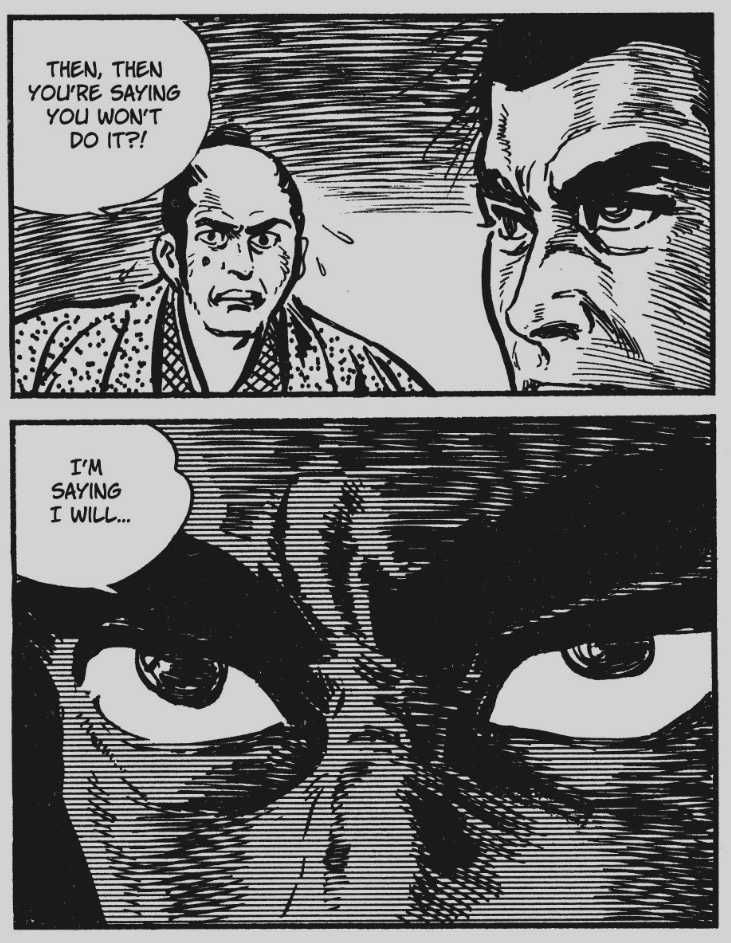
This volume contained several short stories (about 300 pages’ worth all up) which, while tense, are also surprisingly funny. (There’s kids pissing on dignitaries, for example.) They’re also detailed in their communication of conditions under the Tokugawa shogunate: I know a little of the history and kept finding things out as I read.
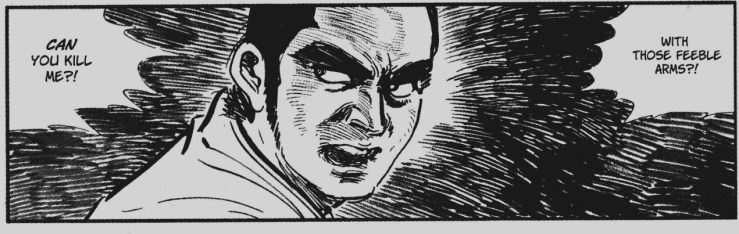
I won’t detail the stories in full as this is only early days in my journey through the series. The basic order of things generally follows the badass arrives in town, some people try to fuck him up and he acts nobly and with horrifically violent panache recipe. And oh, lord, it’s fuckin’ great.
(I have just learned that apparently Darren Aronofsky wanted to take a stab at adapting this but it didn’t happen. Mother with swords? Oh hell yeah.)
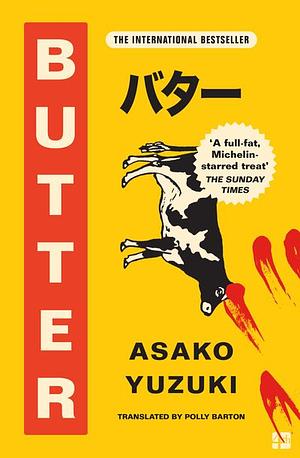
Butter by Asako Yuzuki.
My rating: five stars.
I went into this without knowing very much about it. Turns out that was a good approach: I found Yuzuki’s novel – based on the actions of an actual serial murderer, who’s still sitting on death row in Japan – engrossing and perceptive.
The story told details the relationship between a journalist, Rika Machida, and Manako Kajii, a woman accused of defrauding and murdering lonely men. A retrial is coming up, and Rika is keen to get a scoop, but there’s a snag: Kajii isn’t interested in talking about her crimes. She wants to talk about food instead. And Rika is not particularly interested in food.
‘I learned from my late father that women should show generosity towards everyone. But there are two things that I simply cannot tolerate: feminists and margarine.”
As their relationship develops, power structures shift and Rika investigates cuisine and crime simultaneously, discovering that the experience has tendrils reaching into her own past. The life of a journalist – meeting with sources, getting a bit too deep into research, having less than ideal relationships – is portrayed well, and provides a springboard for consideration of broader themes in Japanese culture. Guilt (both personal and societal) figures, as does the inherent misogyny of the society. Obesity and appearance cop a hiding, while regret and the atomisation experienced by Tokyo residents is explored.
Whichever aspect of it you considered, Rika thought, the Kajii case was tinged by misogyny and the excessive self-pity felt by lonely men. Was thinking that way tantamount to victim-blaming, though? Usually, she loathed the all-too common take that people were responsible for their own destinies.
Compulsion, consumption, reinvention and internal life versus external appearance: underpinned by some incredible descriptions of food, they’re considered at length, but not in a way that inhibits the forward motion of the story. Is it a bit navel-gazey? Yeah, but the characters are all at the point where that just makes sense: the way society dictates you should live versus the experiences of your life are bound to collide in a manner that requires reflection.
I loved it, and can’t wait to get into Hooked, the second of Yuzuki’s novels to be translated into English.
If you’re after some good bookish times, please check out my profile on TheStoryGraph.
If you’d like to buy me some books to review, there’s a wishlist over here.

