
As it’s the first day of a new year, it’s also the time when (apparently traditionally, now) I select a list of potential reads. There’s 25 this year (because 2025 right?) and while I doubt I’ll read them all, they give me something to aim for, and at the very least provide 25 options for when I’m stuck wondering what I should read.
Here’s the list. And a little write-up.
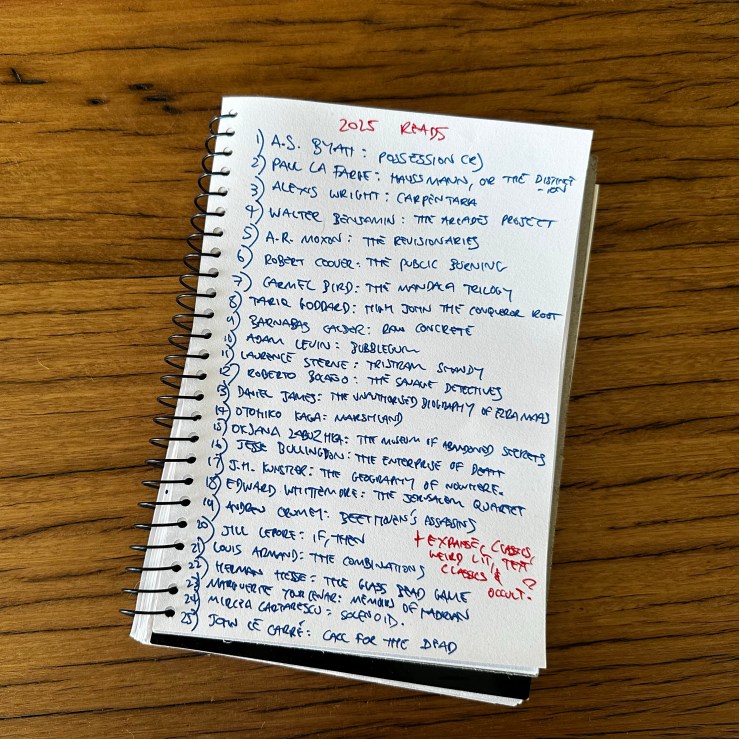
- A.S. Byatt: Possession. This will be a reread. I remember reading this as part of first-year university, and remember nothing more about it than I really enjoyed it. I have a lot of Byatt on the shelf, so I’m hoping this gets me more into her work.
- Paul la Farge: Haussmann, or the Distinction. This could be a hangover from the civic planning-specific texts I read last year. Supposedly this is an excellent novel with the titular Parisian planner at its core. I remember enjoying The Night Ocean when I read it, so I believe this will be good too.
- Alexis Wright: Carpentaria. Filling an unfortunate gap in my reading. I’ve not read any of Wright’s work, though I’ve heard nothing but raves. I also have The Swan Book and Praiseworthy waiting as well. It’s about time.
- Walter Benjamin: The Arcades Project. I scored a not-too-expensive copy of Benjamin’s incomplete (yet influential) work last year, and am undecided whether to dip in or to raw-dog from beginning to end. Either way, I think revelations await.
- A.R. Moxon: The Revisionaries. Cults, mysteries, the blurred line between fantasy and reality? I don’t want to know any more before I dive in.
- Robert Coover: The Public Burning. This will be my first Coover, though hopefully not my last. The description of the book – retelling the lead-up to the Rosenberg executions – feels a bit in the Mailer or Delillo wheelhouse, which is good.
- Carmel Bird: Mandala Trilogy. Madness, cults and deep sleep therapy. Australian gothic horror, thankfully republished for new (like me, though I shouldn’t be!) readers.
- Tariq Goddard: High John the Conqueror. Getting Hawksmoor vibes from the write-ups (detectives, the occult) but as ever, wish to find out for myself. The good thing about things going on these kind of lists is that there’s no way I remember all the reviews I’ve read by the time I come around to reading the books themselves.
- Barnabas Calder: Raw Concrete: the Beauty of Brutalism. Reading this because fundamentally, I love me some enormously monolithic concrete, right? Right.
- Adam Levin: Bubblegum. First Levin I’ll have read – largely because it’s the first I’ve been able to get my hands on physically – this presents an alternative history with fleshy robots and no internet. (Which, let’s face it, sounds a bit good.)
- Laurence Sterne: The Life and Opinions of Tristram Shandy, Gentleman. A classic that’s loitered on my shelves for far too long and is, supposedly, much more modern than you’d believe a book from 1759 to be.
- Roberto Bolaño: The Savage Detectives. Another first, attempting to ease into the writer’s work before tackling that 2666 behemoth.
- Daniel James: The Unauthorised Biography of Ezra Maas. Was there some identity-based hi-jinkery around this book? I vaguely remember this being the case but a) DO NOT REMIND ME and b) I finally got a copy after I’d forgotten all about it, so I’m interested to see how this shakes out with a relatively clean cranium.
- Otohiko Kaga: Marshland. Tolstoy, but make it Japanese. I believe there’s much reckoning with Japan’s society in here, surrounded by lush pastures.
- Oksana Zabuzhka: The Museum of Abandoned Secrets. Sixty years of Ukrainian history in 800 pages, again providing the long view of a crucial part of a society’s history. (History I know next to nothing about, even if this is a fictional take on it.)
- Jesse Bullington: The Enterprise of Death. I enjoyed The Sad Tale of the Brothers Grossbart very much when I read it (though I should reread it as it falls into a non-reviewing memory hole). I’m expecting similar levels of blood and grit from this one.
- James Howard Kunstler: The Geography of Nowhere: The Rise and Decline of America’s Man-Made Landscape. Fits in with that whole civil planning jag I was on. This will provide a slightly newer perspective on the development of US cities (and the spread of sprawl) than either The Death and Life of Great American Cities or The Power Broker, which will be interesting. I think it’ll fit in well with Mike Davis’ City of Quartz: Excavating the Future in Los Angeles, which I would also like to read.
- Edward Whittemore: The Jerusalem Quartet. An alternate history (of the biblical era?) written by an ex-CIA guy. The blurb sounded like a blast and the omnibus ebook was cheap, so here we are. Hoping to be pleasantly surprised.
- Andrew Crumey: Beethoven’s Assassins. In which Beethoven is commissioned to write an opera for the Masons about Assassins. This sounds ridiculous and that’s exactly how I like things. Again bought purely on the strength of the blurb.
- Jill Lepore: If Then: How One Data Company Invented the Future. The birth of big data. The book has been described as telling the story of an entity that was “Mad Men crossed with Theranos” so I’m expecting some serious lapses in judgement and ethical disregard.
- Louis Armand: The Combinations. One bought purely because the PynchonBros seem to rate it. Is it revelatory? Overwritten? LET’S SEE!
- Herman Hesse: The Glass Bead Game. This will be a reread, as I read the novel many years ago and am fairly sure I had no fucking clue what was going on. Here’s hoping thirty years have given me a leg up in the comprehension stakes.
- Marguerite Yourcenar: Memoirs of Hadrian. Historical novel that combines a classical record with literary chops. Another of those books I feel dumber for having not read yet.
- Mircea Cărtărescu: Solenoid. Recently, I picked up a physical copy of this. I have had a digital copy since it came out (to much fanfare) which I have now pretty comprehensively forgotten, so I think I’m in the right headspace to have my mind blown.
- John le Carré: Call for the Dead. I want to start reading the George Smiley novels as I’ve never actually read any le Carré before. I’m familiar with adaptations of the work, but figure this first instalment is the best place to start .
- Plus novels from The Expanse. (Continuing on the buddy reads I’ve been on with the James S.A. Corey series. I’m three novels in now, I think, and want more.)
- Plus classics. (The bookshelves of black spines are calling.)
- Plus weird lit. (The black spines in space are calling.)
- Plus Text Classics. (The yellow spines are calling.)
- Plus occult. (The void is calling.)
I think that’s as good a place to start as any. As ever, there’s a note on my phone with other potential reads that grows as the year progresses – but these are the ones I’d like to get through.
Let’s see how it goes.


[…] more, I planned 2025’s reads on the first day of the year. Once more I kept my suggested book numbers in line with the year: 25 for 2025. I was a bit more […]