Book review: Loomings Over the Suet

Loomings Over The Suet Loomings Over The Suet by Glen Baxter
My rating: 3 of 5 stars

The last Glen Baxter book I read was The Billiard Table Murders, about fifteen years ago. Like that title, Loomings Over the Suet is a mystery of sorts, full of police procedure and deduction – albeit with fish in buckets and weird looking radio transmitters. And alphorns.

The narrative doesn’t really make sense, but anyone au fait with Baxter’s style won’t expect it to. If laid out on a page, there’d probably be an A4-worth of story. You can read the book in fifteen minutes or so. But then, you’re not going to be reading Baxter for narrative coherence. Continue reading “Book review: Loomings Over the Suet”
Book review: A Clash of Kings

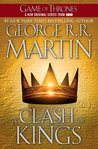
A Clash of Kings A Clash of Kings by George R.R. Martin
My rating: 4 of 5 stars

So, the second in the lengthy (and let’s admit it, perhaps never-to-be-completed) A Song of Fire and Ice series.

Reading this one took a little longer than the first. There’s nothing in the prose that’s changed too much, but it lacked – until the later battle passages – some of the quickfire snap of the first volume. Perhaps it’s as it spreads itself a little more widely? In the first novel there was simply Westeros and the Dothraki plains, pretty much – other places were mentioned, but the reader could pretty much think “cod-England and that sandy joint” and be pretty well situated. But here there’s more happening in Daenerys’ storyline in actual cities. It’s no longer courtly life versus who-are-these-horse-dudes? hardships. Continue reading “Book review: A Clash of Kings”

Write what you know and read what you like

My university years.

A story on Slate has sparked a bit of commentary about reading and snobbery. I suppose it’s easy clickbait – nobody wants to feel inferior about their choice of pastime – but once you read the sell, there’s really not a lot more to it:

Read whatever you want. But you should feel embarrassed when what you’re reading was written for children.

Hm. Throughout there’s more of this looking-down-the-nose kind of thing, somehow suggesting that eye-rolling and enjoyment of what may be crap-lit are mutually exclusive. What I don’t understand is where speculation like this

These are the books that could plausibly be said to be replacing literary fiction in the lives of their adult readers. And that’s a shame.

or

But if they are substituting maudlin teen dramas for the complexity of great adult literature, then they are missing something.

comes from. I mean, aside from hanging the whole thing on what adults might be doing.

Continue reading “Write what you know and read what you like”

Book review: A Game of Thrones

A Game of Thrones A Game of Thrones by George R.R. Martin
My rating: 5 of 5 stars

So, knee deep in the fourth season of the HBO adaptation of the cycle, I decided to read the source: George R.R. Martin’s books. And it’s the good choice: having seen the shows I’m already given a mental Cliff’s Notes to the tale, and I’m not likely to be disappointed by how the shows had dumbed-down the books; rather, I’m left in the position of learning how much the show leaves out. Continue reading “Book review: A Game of Thrones”

Robot songs of bookish love

This article is great, because it details the process by which an algorithm – called TransProse, no less – can take the ’emotional temperature’ of literature and generate a piece of music on the results. Such as this, gleaned from A Clockwork Orange.

I’m kind of thrilled about this because I’ve always loved the way computers can take stuff we’ve created and make things from them. When I was younger, I used to play around with a DOS program called MARKV, which would eat any text you fed it – the longer the better – and then return output based on Markov Chains. It was random but it also relied on statistical examination of what pieces of data sat next to, so you’d receive something back which followed the kind of rules required for construction of lucid text… but in a very strange way.

I’ll wait. There’s an online version here. Go check it out. Or, better yet, feed album reviews or party political statements into it: the result is no more confusing than the real thing.  Continue reading “Robot songs of bookish love”

Book review: The Undeground Man

The Undeground ManThe Undeground Man by Mick Jackson
My rating: 4 of 5 stars

Jackson’s Booker-shortlisted book is a real gem. It’s a strange amalgam of fictionalised history, memoir and gothic horror – gothic body horror, come to that.

It takes its genesis in the life of William Cavendish-Scott-Bentinck, 5th Duke of Portland, but rapidly diverges from the accepted record. Using a combination of diary entries and testimonies or statements, the mole-like additions to his home at Welbeck Abbey are described, as is his increasing infirmity. There’s a lovely turn of phrase in the Duke’s private reminiscences, and the reader if left wondering if it’s the result of a poetic soul, or of dementia. Continue reading “Book review: The Undeground Man”

Book review: Zodiac and Zodiac Unmasked

Two book reviews for the price of one. Read before a re-watch of David Fincher’s Zodiac because these were instrumental in its creation. My advice? Stick with the film. There’s a little repetition in the reviews because REPETITION IS WHAT YOU GET FROM READING THESE BOOKS, BUCKO.

ZodiacZodiac by Robert Graysmith

My rating: 3 of 5 stars

Cartoonist-cum-chronicle Robert Graysmith has a pretty decent retelling of the Zodiac killer story here. As well he should, given he was working at one of the newspapers to receive ciphers and cheery letters from the murderous astrology fan. Continue reading “Book review: Zodiac and Zodiac Unmasked”

Book review: The Fool’s Journey

The Fool's Journey: the History, Art, & Symbolism of the TarotThe Fool’s Journey: the History, Art, & Symbolism of the Tarot by Robert Michael Place
My rating: 3 of 5 stars

Published to coincide with an exhibition of tarot art curated by the author, The Fool’s Journey sits in a weird position. It’s a little too complex to be just an exhibition catalogue, but it’s also too slender to be a fully-considered work on the tarot. (Place is a respected artist, tarot scholar and has written more lengthy works on the cards, lest it be thought I impugn his credentials as a well-researched writer.)

Part of the difficulty with the book is that I think it’s a little user-unfriendly, at least as far as the layout goes. It’s a larger-format book, which is excellent for the graphics, but the text pages are one-column and stretch the whole page, making navigation difficult and reading a little tiring. I believe it’s a self-published work – the publisher’s address appears to be the author’s – so that explains some of the errant typos that appear through the work. It’s not a deal-breaker, though it does knock the faith in the work a little.

The good, though, is the amount of graphical reproduction on hand. Continue reading “Book review: The Fool’s Journey”

Book review: Hey Nostradamus!

Hey Nostradamus!Hey Nostradamus! by Douglas Coupland
My rating: 3 of 5 stars

Hey Nostradamus is the story of absence, told by a quartet of characters. It’s direct, chilling and full of yearning, and will relentlessly bum you out if you’re feeling down.

It’s interesting – while I recall Microserfs as being both grim and amusing, this title is mostly grim. There’s some beautiful turns of phrase, though – some crystal-clear moments of almost theological brilliance. Fitting, I suppose, as one of the characters (paterfamilias Reg) is as pursed-lips holy-roller as you’ve seen in print. His section of the book – the last – is in particular filled with a sort of quiet beauty. Continue reading “Book review: Hey Nostradamus!”

Book review: The Luminaries

The Luminaries The Luminaries by Eleanor Catton
My rating: 4 of 5 stars

I lived in New Zealand for a couple of years, so I am pretty positively-disposed towards the book, which reminds me very well of the shape of the country. Catton has constructed a great portrait (albeit historical) of the goldfields. Think Deadwood, bro: there’s Celestials and whores, scarred bastards and scheming brothel-keepers, proud proprietors and prospectors lacking a clue. There’s often a sense of style over substance – motivations for some characters’ actions are often considered to be an adequate portrait, leaving some appearing a little one-dimensional – but the ambition is huge, and the story well-told. Continue reading “Book review: The Luminaries”