So hey, remember how this year I was going to be more measured about getting my reviews written up and out into the world (or this creaking edifice, at least)? And how I was going to make it easy for myself and everyone?
Allow me to borrow a quote from David Mamet’s screenplay for Ronin.
So what could have been concluded in a collegiable atmosphere is now fucked into cocked hat.
Yep, it’s another post featuring 20 reviews. Buckle up.
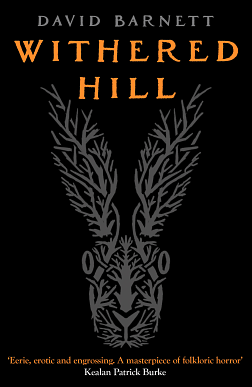
Withered Hill by David Barnett.
My rating: five stars.
As someone who lives rurally in a smallish community (well, outside of two smallish communities) I am a big fan of stories about smallish communities that look great but have some kind of terrifying secret. Especially if weird animal masks and honouring of the old ways is prevalent. Especially especially if there’s some kind of mysterious transfer from everyday life into a folk horror nightmare.
Over the last seven weeks, Sophie has had much time to reflect on her arrival in Withered Hill. An arrival suggests a journey, and a journey indicates a starting point. She cannot remember where she came from, or why.
Withered Hill tells the story of Sophie, a woman who feels left behind in her life. Her friends’ lives are moving on – marriages, kids, overseas jobs – and she’s in the same world of temping and spending too much cash on booze. She’s stuck.
Then she ends up somewhere called Withered Hill. A place where Owd Hob rules, and where the outside world doesn’t make much of an appearance. A place apart.
‘Why am I a prisoner here?’ says Sophie sullenly.
‘You’re not a prisoner. You just can’t leave.’
‘Is there a difference?’
The story unfolds in a two-timeline method: Inside and Outside, non-sequential. It’s the story of Sophie’s becoming, of her self-discovery, of her attempt to learn what is going on in Withered Hill, and why. It’s a story of change, though. not necessarily of improvement. It’s an excellently chilling horror that works without being particularly gory – the thought of an older, less familiar form of life lurking just under the surface of the regular is effectively and disconcertingly conveyed.
When I finished this I ordered a couple of Barnett’s other books, both of which appear to be set in similarly small towns. It’s a furrow I’m happy to explore.
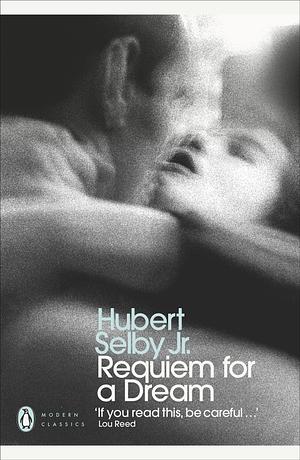
Requiem for a Dream by Hubert Selby Jr.
My rating: five stars.
Obviously I was feeling too good about myself earlier this year and decided that the only way to rectify that would be to read the based-in-painkiller-and-heroin-addiction novel that formed the basis for Requiem for a Dream, a film with an absolutely killer soundtrack and a soul pummelling intensity that means it’s one of my favourite films, but one that I can’t say I actively enjoy due to the fact that it’s like being repeatedly punched in the soul.
At the conclusion of this book I realised that Aronofsky’s film was the most straightforward of adaptations .If anything, the film underplays the destructiveness of addiction when compared to Selby’s novel.
The novel, written in a stream-of-consciousness style without apostrophes, has the urgency of palpitations. It follows the story of Harry Goldfarb and his mate Tyrone, continual pawners of mother Sara’s TV in the pursuit of drugs. Sara needs her TV, however, and buys it back from the pawnshop whenever it’s put in hock. Because you see, the TV is all that she has in her life – and there’s a chance she might end up on it, you see.
What have I got Harry? Why should I even make the bed or wash the dishes? I do them, but why should I? Im alone. Seymours gone, youre gone – Harry tried to protest but his mouth hung silently open – I have no one to take care of. Ada does the hair. Anybody. Everybody. What do I have? Im lonely Harry. Im old.
Harry’s girlfriend Marion is a nice girl, but Harry’s habits become her own and ensure that her dreams of arty cafes end up spiralling away. Spiralling is the defining movement of the book, as each of the leading foursome are pulled down into the depths of their addiction, and wrecked on the shores of madness, prison and deeper addictive depths.
Harry and Tyrone were slowly absorbed by the cesspools they were spending more and more time in. It was a gradual progression, like most diseases, and their overwhelming need made it possible for them to ignore much of what was happening, distorting some, and the rest accepted as part of the reality of their lives.
This is an incredible work. It’s harder to take than the film because despite feeling a little dated due to the language of the time of its writing, the construction of the book is so much more direct. It’s a snap-kick to the head, and the stories are communicated so unflinchingly – even though their participants wrap themselves in denial – that it’s almost painful to learn what’s coming. (Particularly where Sara Goldfarb is concerned.)
I can’t say I enjoyed it, but my god, what an absolute triumph.
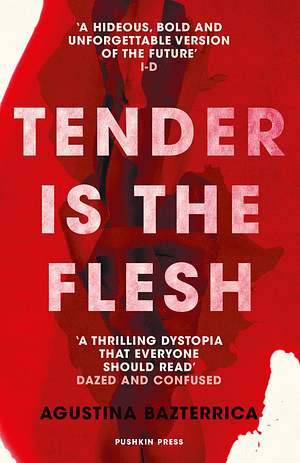
Tender is the Flesh by Augustina Bazterrica.
My rating: five stars.
Another book that made me feel absolutely shithouse and another five stars. There could be a bit of a developing theme here.
Bazterrica’s novel is set in a post-pandemic world where animals have been wiped out. Vegetarianism being an unsuccessful option for food security, there’s been some discussion and a decision arrived at.
His brain warns him that there are words that cover up the world. There are words that are convenient, hygienic. Legal.
Yep. A particular class of humans – referred to as heads, as in heads of cattle – exist solely for eating purposes. Gotta get that protein in, after all.
Marcos runs a factory that processes heads, and the novel explores how his world is controlled. by the anaesthesia of language, to cover the monstrous nature of what’s actually going on. There’s an us-and-them delineation at work: they’re food, we’re just workers, doing what’s required to make quotas.
Naturally, things aren’t that simple. The reality of feedlots, of forced insemination, of slaughter, are described in a manner that is understated yet creates that raw-nerve jangle that splatterpunk sometimes serves. It’s quite a trick, and I assume both Bazterrica and translator Sarah Moses have worked hard to ensure the language of the spreadsheet provides a fig leaf for the ultimate taboo.
The owner of the tannery is always smiling and he feels that when this man observes him, what he’s really doing is calculating how many metres of skin he can remove in one piece if he slaughters him, flays him and removes his flesh on the spot.
It’d be easy to write this off as an updated Soylent Green but there’s more to it than that. (And no Chuck Heston.) It’s a critique of avarice, of capitalism, of human desire. Marcos’s story, despite his best intentions, experiences some very human roadblocks and the end isn’t as clean as he might wish.
I’m still thinking about this. Its implicit gore gave me pause throughout my reading: plenty of times I wondered whether I could persist. I’m glad I did, but again: don’t look for enjoyment.

White Jazz, American Tabloid, The Cold Six Thousand and Blood’s a Rover by James Ellroy (reread).
My rating: four, five, five and five stars.
This brace of audiobooks follows on from my noir-heavy reading earlier in the year. Again is an audiobook excursion because the dynamism of Ellroy’s work is the perfect fodder for a good narrator.
First up, White Jazz: a novel that I very much enjoyed, and that brings Ed Exley’s arc to what appears to be a close. It’s the story of Dave Klein, a crooked cop almost comically bent (I mean, he throws witnesses out of windows at the behest of Mickey Cohen and Sam Giancana) but is compelling despite it all. Is it another collection of bad men doing bad things? Well, yes, but it’s a satisfying capstone to Dudley Smith’s fuckery, so that papers over a lot of cracks.
My first read of these rest of these books was fairly obsessive. I was going through a bit of a James Ellroy stage – in my experience, the only way to consume his work, driven as it is by main-character obsession, regardless of the setting – and I recall reading the first two novels of the Underworld USA trio (American Tabloid and The Cold Six Thousand) a couple of months before Blood’s a Rover came out.
I think that a couple of decades between drinks (and knowing a bit more Cold War history at this point) primed my enjoyment of what occurs in this trio. Spanning 1958 to 1973, it covers the assassinations of John F. Kennedy, Martin Luther King Jr., and Robert F. Kennedy. The period covers the waning power of J. Edgar Hoover, the abortive casino-ification of the Dominican Republic, roiling race tensions and the horrors of the Vietnam War, that brought America’s misdeeds into the living rooms of its populace in a new, terrifying way.
The construction of the novels is masterful. Each features three contending narrators, providing patchwork coverage of the stories of cross-and-double-cross within. As ever the narrators are mostly men, mostly fitting in that space where the difference between a true believer and a mercenary is the flip of a coin. The destruction of these men – Kemper Boyd, Ward Littell, Pete Bondurant, Wayne Tedrow Jr., even J. Edgar Hoover himself (look, who doesn’t love Archie Bell, even if he is apparently some harbinger of societal collapse?) – is minutely plotted, to an extent that the hopped-up-on-goofballs pace of Ellroy’s prose would make one believe impossible. It’s like being socked in the head repeatedly, but I kept going back for more, to see how far the conspiracies within stretched.
The answer? All the fuckin’ way.
Ellroy finished the Underworld USA trilogy just as the Watergate scandal was looming. I’ve read that Watergate and the Nixonian footwork that followed bored him, which I can understand: the world of King, the Kennedys and Hoover is a compelling one. As he puts it,
The essential contention of the Underworld USA trilogy … is that America was never innocent. Here’s the lineage: America was founded on a bedrock of racism, slaughter of the indigenous people, slavery, religious lunacy … and nations are never innocent. Let alone nations as powerful as our beloved fatherland.
This is one hell of an unvarnished history lesson, and I loved it all – especially the curiously Hardy Boys vibe of Blood’s a Rover. I’d love to see a decent adaptation of the Underworld USA trilogy, but I think nowhere would be willing to invest the runtime or the effort needed to make it truly sing, which is a pity. Until then, audiobooks are probably your best bet.
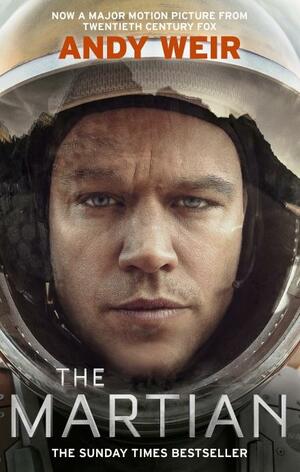
The Martian by Andy Weir.
My rating: four stars.
No, I haven’t seen the movie (which is reputedly great). No, I hadn’t read anything else by Weir. Yes, this was bought on sale (before the Matt Damon tie-in cover which has now forcibly turned up on my device) and yes, it sat on my Kindle shelves for a couple of years.
Yes I enjoyed it and yes I will watch the movie now. Happy?
The Martian is a story about being left behind on Mars.
Remember those old math questions you had in algebra class? Where water is entering a container at a certain rate and leaving at a different rate and you need to figure out when it’ll be empty? Well, that concept is critical to the “Mark Watney doesn’t die” project I’m working on.
It’s a problem to be solved: how to survive until someone notices. The book unspools from that point: Mark Watney has to apply his smarts in the hope that NASA realises they’ve fucked up and somehow figure out how to get him off the red, dusty rock that isn’t particularly well equipped for survival.
I have duct tape. Ordinary duct tape, like you buy at a hardware store. Turns out even NASA can’t improve on duct tape.
This is a quick read that is full of pop-culture observations and problem-solving escapades. Leaking habitat? How much air can he afford to lose? How far is it to a better location? What can he eat in the interim – and how can it be made to grow?
There’s a lot going on. I started off being annoyed by the main character’s down-home nature. It felt a bit one-note, a bit too… Forrest Gumpy? But the overwhelming stakes of the story eventually reeled me in, and this proceeded as a solid popcorn read, telling the story from three locations – on Mars, in a ship currently heading home, and on Earth – in a way that ultimately ties up pretty well.
After completing this, though, I have to unfortunately report that Weir doesn’t see it as his role to have a political or social aspect to his books, which seems either a disingenuous or stupid take for someone who writes science fiction to have. I understand that this is in the context of him having the shits with his idea for Star Trek being shitcanned, but to think politics or social issues can be divorced from SF? Come the fuck on, guy.
So yeah, I enjoyed this one, not sure I’ll be lining up for another super quickly, solely because I like there to be a bit more than pew pew going on in my SF, and will probably prioritise writing with something interesting to reflect on the world, not just physics-problem mental masturbation, enjoyable as that might seem.
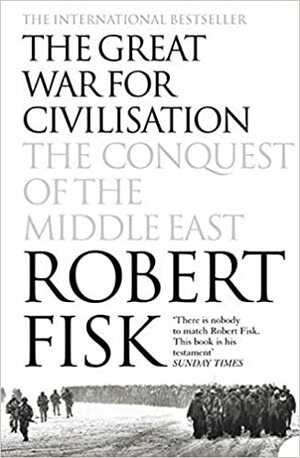
The Great War for Civilisation: The Conquest of the Middle East by Robert Fisk.
My rating: five stars.
This is one of those books that I felt really stupid for not having read before and incredibly angry now that I have read it. It is an exceptional collection of writings on particularly gruesome parts of the 20th century including multiple Gulf Wars and countless atrocities, penned by one of the greatest (and often most derided, though he was ahead of the curve in pointing his finger at the West’s complicity in wartime horrors) writers to discuss the Middle East.
So yeah, it’s another fun one. It’s not all bad, though. There’s moments of excellent levity.
But with increasing horror, I realised that the dishevelled correspondent who had burst in upon their sacred home had introduced himself in Pushtu not as a reporter but with the imperishable statement: ‘I am an English satin bag.’
I won’t go into what’s covered here in full detail, but it suffices to say that Robert Fisk is unafraid of pissing on his own image. I mean, this is the guy who was the first Western journalist to meet Osama bin Laden – an introduction brokered by Jamal Khashoggi.
On a mountaintop in Afghanistan, I sat opposite Osama bin Laden in his tent as he uttered his first direct threat against the United States, pausing as I scribbled his words into my notebook by paraffin lamp. ‘God’ and ‘evil’ were what he talked to me about.
His bona fides are solid, and the fact he survived his postings is incredible, given how close he was to the destruction of these lands.
The book’s title refers to words appearing on one of his father’s medals from the First World War. They’re important, because the general thesis of the work is that all of the horrors within are the result of the dividing of territory hammered out in the postwar period. The harms that have resulted came directly from that period, from the armed colonialism that underpinned the time.
In all, it was to take my father’s generation just twenty-three months to create these artificial borders and the equally artificial nations contained within them. The new state of Great Lebanon was torn from the body of Syria and inaugurated by General Henri Gouraud on 30 August 1920. The constitution of Yugoslavia, the so-called Kingdom of Serbs, Croats and Slovenes, was promulgated on 28 June 1921. And the Anglo-Irish Treaty that partitioned Ireland was signed less than six months later, on 6 December.
The League of Nations approved Britain’s Palestine mandate – incorporating on 22 July 1922, eleven months after the terms of the Balfour agreement King Feisal, the son of Sherif Hussein, was set up by the British as king of Iraq. And it is, as I often reflect, a grim fact of my own life that my career as a journalist – first in Ireland, then in the Middle East and the Balkans has been entirely spent in reporting the burning of these frontiers, the collapse of the statelets that my father’s war allowed us to create, and the killing of their peoples. It is still a quaint reflection on the spirit of that age that most of the redrawing of maps and setting up of nations was supposedly done on behalf of minorities, minorities who in almost every case but two – that of the Jews of Mandate Palestine and the Protestants of Northern Ireland – did not want their maps redrawn at all.
This is the lens that informs everything that follows, right up until the period just following the September 11, 2001 attacks. There’s details on holocausts or massacres (Armenia and Algeria) I knew next to nothing about; explanations of the reasoning behind suicide bombers; the horror of what happens to children hit by shells or rounds. The role of our governments in arming warlords and looking the other way when they committed human rights atrocities. And the importance of journalism in the face of all this unspeakable shit, to communicate to the population the reality of our geopolitics, beyond what the talking heads of the governments at the time might say.
What was interesting was the vastly different reaction in East and West to our abuses at Abu Ghraib. We ‘civilised’ Westerners were shocked at the dog-biting and humiliations and torture ‘our’ men and women administered to the inmates. Iraqis were outraged, but not shocked. Their friends and relatives – some of whom had been locked up by the Americans – had long ago told them of the revolting behaviour of the American guards. They weren’t surprised by those iconic photographs. They already knew.
This is a hard, but absolutely vital read. If you have any interest in the Middle East – and given what’s happening in the Gulf at present, you fucking should, then you need to read this. It is an incredible, terrible work .
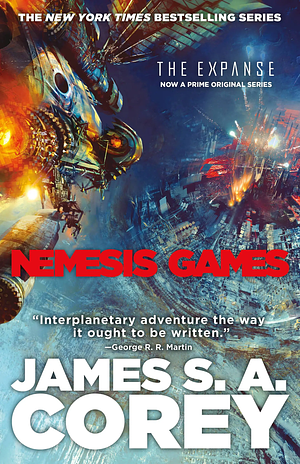
Nemesis Games by James S.A. Corey.
My rating: five stars.
OK, so you know by now that whenever I’m on a James S.A. Corey trip it means two things: 1) a Storygraph buddy read with Elizabeth (go buy stationery) and 2) popcorn city motherfuckerrrrr!
This one delivers on both counts. Opening with a daring raid, Nemesis Games is probably one of my favourite entries in the series so far. It fills in a lot of Naomi’s and Amos’s backstories – there’s plenty of oh shit! moments – and manages to work in conspiracies, Alliance fuckery and the settlers’ rush in space that was begun in the previous novel.
The really frightening part is that something else came along, shot the first guys in the back of the head, and left their corpses scattered across the galaxy. The thing we should be asking is, who fired the magic bullet? And are they going to be okay with us taking all of the victims’ stuff?
I mean, that, and alien superintelligence. And terrorism. And a curiously appealing killer-and-beefcake buddy-movie-on-a-bike that had me grinning pretty much the whole time.
“Oh, now we’re expecting this shit to make sense?” Amos asked. “Gimme that naan.”
While it does feel like this novel is setting up the chess pieces for the next stage of the broader narrative, I never felt like I was marking time. This was a completely engrossing look at the bonds that a crew under pressure form, tested only when they’re away from each other. It deepened character portraits and made me feel closer to them – or at least, more understanding of their drives and their apprehension of the world(s).
It’s solid, I loved it, and I can’t wait to see what’s next. James mentioned that he couldn’t understand how I’m going so slowly through these – I’m trying to make the goodness last, because oh man, the anticipation is delicious.
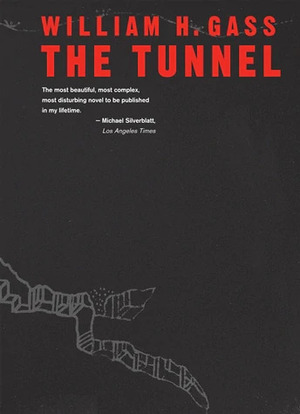
The Tunnel by William H. Gass.
My rating: four stars.
Another literary behemoth crossed off the list. The Tunnel is a novel that took its author nearly 30 years to write and deals with how one man’s obsession (the man: an academic, William Kohler; the obsession: his scholarly work on guilt and Nazism) worms its way into a description of that man’s own life, called The Tunnel.
It’s an unflattering, 12-part description of Kohler. So unflattering that he hides it in the pages of his scholarly work (the grimly titled Guilt and Innocence in Hitler’s Germany) and starts to build an actual tunnel under his house, hiding the dirt of his diggings in antiques his wife will at some point sell.
This is a novel where having a grip on the structure really helps. Gass has mentioned that the beginning of the book is difficult by design, to ensure the person who gets past it is willing to put in the work to enjoy the rest of it. That sounds like a dick move, but it’s really a good approach: I had difficulty reading this, and I’m sure there’s elements that went above my head, but if it’s not the thing for you, having a no-qualms reason to chuck it on the DNF pile at an early stage (rather than two-thirds through) is a boon rather than a drawback.
I imagine that creating this must’ve been something like workshopping a Swans album. See, that bunch of guys create music that’s incredibly confronting and uncomfortable, possessed of an almost offputting intensity of purpose. Actually getting to the point where the music is done must be an incredibly gutting series of events. Gass has created the equivalent of something steered by M. Gira: an immensely nasty examination of an unlikeable character that, while unflinchingly honest and generally awful, is so precisely honed and carefully constructed that one cannot look away.
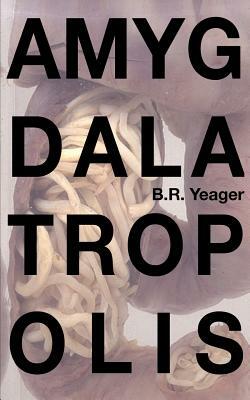
Amygdalatropolis by B.R. Yeager.
My rating: three stars.
A few years ago, I read Yeager’s Negative Space, which was an incredible work of drug horror. I’ve had this book on the must-read list since then, largely because it was the sort of thing I’d have to track down physically to read. (It’s not, or at least wasn’t, available as an ebook.)
I received a copy for my birthday this year, so on I went.
Unfortunately, this is no Negative Space.
The book is experimental and horrific, which is something I appreciated. It’s basically what if a 4chan poster existed in real life: the book which, if you’ve been paying attention to incel and manosphere culture, is something horrifically present today. When this book was published in 2017, these things weren’t as mainstream as they are now, so Yeager receives points for creepy messageboard prescience.
What we get is the story of a shut-in and their eventual trip down the Internet of Shit: from conversation to gross-out, to grim wanking over violence. It’s a world of violent simulation – maybe – that spills into the mind, bringing some kind of accelerationist, transhuman sepsis with it, making the online travails of user /1404er/ an indicator of Where We’ll End Up If We Keep Doing This Online Shit.
It’s intense, yes, but it felt a little unfocused (when compared with Negative Space, which is perhaps an unfair comparison) and potentially a bit high on its own farts. Still, as a depth-sounding of anomie? Not bad at all.
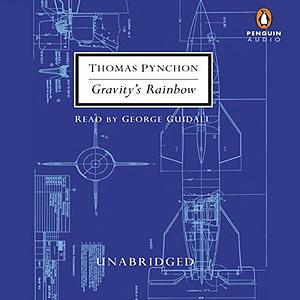
Gravity’s Rainbow by Thomas Pynchon (reread).
My rating: five stars.
I first read this book at university almost 30 years ago. It wasn’t my first Pynchon – that was the far more approachable The Crying of Lot 49, a work I’ve read that was written to be popular and lay the groundwork for acceptance of something as oblique and weighty as Gravity’s Rainbow.
I read it in a class called Transatlantic Connections, a look at literature on either side of that ocean through various time periods. The class was run by Drs Dave Kelly and Don Anderson, probably my favourite lecturers and also the guys behind the class that taught me to love Ulysses, so you’ve probably got them to blame for my wanky choice of literature, but I have nothing but eternal thanks.
Anyway, I remember having roundtable discussions about what was going on in the book – replete with a full reading of the part of the novel involving terrible English confectionary (IYKYK) and feeling that it was a dynamic text, more alive than other books I’d read.
I have reread it between then and now, but I don’t recall much about that reading, so I suspect it was when I was grinding out the novels to meet arbitrary numbers rather than for enjoyment (chasing stats is not always good, folks) so I have decided that read doesn’t count.
This time, however, I decided to audiobook the thing. George Guidall’s 1986 recording is an incredible artefact, and highlights the fact that, like the similarly encyclopaedic Ulysses, GR is a modern epic, designed to be heard aloud. There’s a music in its profane actions, in its mock-serious history. And Guidall is a joy to listen to. If you’re someone who is cowed by the reputed difficulty of this book (which TBH is overdone if you approach it with the knowledge that some bits will go over your head and the joy is in the momentary description, not the overarching whole) then the audiobook is absolutely the way to go. The book itself is great, but the reading makes it stellar.
The story is a bit hard to nail down. Broadly speaking, we follow a cast of characters (most notably the American Slothrop, who has an unusual physical reaction to rocketry) who are sometimes real people and sometimes not, through the wreckage of World War II and its aftermath. A world is fractured and being remade, conspiracies are afoot, bonds coming together and flying apart. This is a world of physics, of action and reaction and of things changing by dint of observation.
It’s a lot.
But that’s the point, really: Pynchon is a noted recluse, known for being photographed only a handful of times in his life. – his turn on The Simpsons features a paper bag, for fuck’s sake – studied engineering physics, spent time in the US Navy, studied under Nabokov, and worked for Boeing as a technical writer penning bits on missiles.
It’s safe to say that that background adequately marks him out as someone with a questing (or, better yet, restless) mind. He’s a conspiracist though one girded by dark humour rather than prepper buckets and extreme firearm collection. And so this novel is full of (and at some points, suffers from) an obsessive’s attention to detail, given that even the smallest parts of the narrative appear to be minutely researched and verifiable. It’s a lot and at times the narrative suffers as a result.
Could this be shorter? Sure. But to pick at some of the detail in here would be to lose the goblin-boy weirdness that is the reason it’s so successful a look into a fractured world.
Something else that appears throughout Pynchon’s works, but is especially prevalent here: music. There’s a song for every occasion, and it’s probably the thing that both endears and irritates in equal measure – they underpin the essential unseriousness of this very serious work, but they’re also a bit come on, man at the same time. I mean, there’s only so many rocket-fucking rhymes that one person can tolerate, even in a book of this size.
Sidebar: songs are so important to Pynchon’s work as a whole that there’s been academic study of them, with 927 counted (though I’m this doesn’t count those in Shadow Ticket) and even albums recorded – here’s one for this very work.
Anyway, the appearance of so many tunes here made me think what would be the most appropriate musical soundtrack to the novel. And what I came up with reflects the speed of both the action and the interconnected zaps of what I can perceive of Pynchon’s brain through the text.
I think you can get the same effect from this album as you can from reading the novel: a firehose of ideas, too much to take in at once. Some cheesy, some profound, but an incessant stream from a questing mind, that may not make sense at the time but will stick around like a loose tooth’s reminder.
You may not like either, but that’s OK: those that do will fuckin’ love it. I’m firmly in the latter camp: now that I’ve reread it after years of lit-boy remembering my first time through, I love it for its flaws and its reaching and the fact I could engage with it as a story rather than a mountain to be summited, or a Cool Thing to check off my list.
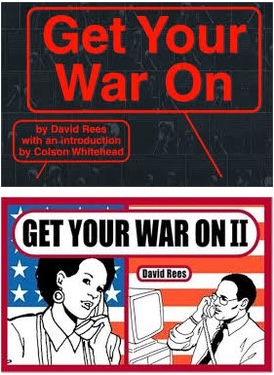
Get Your War On and Get Your War On II by David Rees (reread of webcomic).
My rating: three stars each.
It’ll be the 25th anniversary of the September 11 2001 attacks this year. It’s pretty astounding to realise that there’s entire generations born since that poor excuse for security theatre and ongoing military fuckery happened.
Is it as astounding as realising how old those albums you really liked as a teenager are, now? Or how old you are, by extension?
Probably not.
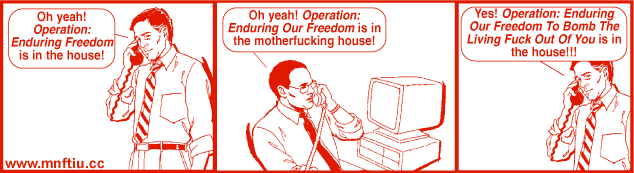
Back in the early days of this blog, I remember reading each new strip as it arrived, speaking truth to the ongoing fuckery of the US-led War on Terror. It was something that spoke to the panic in everyone’s lives at that point, the fear of not knowing what was going to happen (but the even greater fear that it was going to be more of the same, only worse).
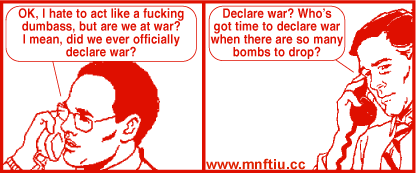
Reading it now is distinctly strange, because as the Propellerheads (ft. Miss Shirley Bassey) once said, it’s all just a little bit of history repeating. I can only gesture ineffectively at geopolitics at this point because… well, you know. I’m not the best person to say what a first-time read of this would be like, but there was a horrible sense of deja-vu happening for me as I went through this again.
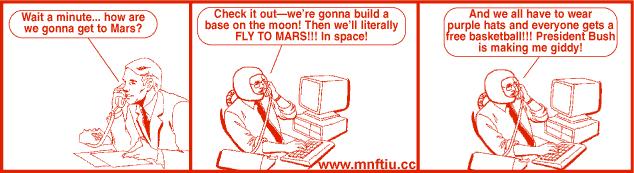
Though it hasn’t been updated in five years, Rees’ website contains the whole run of the comic, still. You might need to dig around for it, but it’s all there. Dive in.

Enshittification: Why Everything Suddenly Got Worse and What to Do About It by Cory Doctorow
My rating: four stars.
You’ve absolutely heard about this. Cory Doctorow (him of the Boing Boing-but-not-no-more association) has been all over the shop with this term. The Macquarie Dictionary made it their word of the year in 2024. It’s had a lot of airtime because it generally conveys how the internet of the future became the internet of shit, bit by paywalled bit.
Here is how platforms die: first, they are good to their users; then they abuse their users to make things better for their business customers; finally, they abuse those business customers to claw back all the value for themselves. Then, they die.
So you know, that’s… most of the internet now. What’s presented in Enshittification is a bulked-up version of Doctorow’s blogposts on the concept, covering a lot of ground: the cost to leave services that keeps you on them, potential ways to regulate services and halt enshittification, how to try and grab a branch on the bank of this shit river.
And it’s fine. I feel like I should crank it down to three stars, now that I’m considering it a couple of weeks after I first finished it: it was entertaining, but that may well be down to the fact that Doctorow reads the audiobook himself in a manner that veers between endearing and immensely punchable. I agreed with a lot of what was in there, and I too wish for something better. But I’m not sure the tone of this thing is going to convince anyone but those already on board.
(Anyway, read this for more of an idea.)
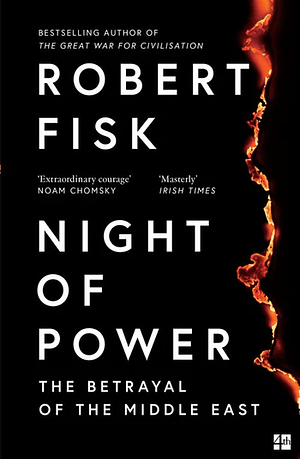
Night of Power: The Betrayal of the Middle East by Robert Fisk.
My rating: four stars.
Because I wasn’t feeling sufficiently bummed about the state of the world and the West’s role in enshittifying the geopolitical game, I figured that another Robert Fisk book might be the go.
This one was posthumously published, as Fisk died in Dublin in 2020. It is a testament to his continued anger at the way those with power are seemingly held free of responsibility for the acts they instigate, and the greed that underpins their decison making. He has a particular ire for Blairite and Bushian yes-men, the sort of people who enmeshed the world in eternal campaigns against an idea (terrorism) based on dodgy information and with little thought to the stirring up of Trouble Down The Line that might result. It picks up from where The Great War for Civilisation left off, covering the Arab Spring, the Syrian war and Israel’s occupation of the West Bank and Gaza. Importantly, it covers how protection of civilians has eroded since September 11, 2001, to the point that humanitarian crimes are now de rigeur for the supposed good guys.
Rarely has the road to perdition been so neatly catalogued. The violence of invasion was eagerly photographed. The economic pulverisation could be acknowledged in a series of ad-hoc laws, press conferences and complex energy deals. But the shock of ‘torture’ was not supposed to be revealed so flagrantly, certainly not with privately owned digital cameras. The camera was indeed a suicide bomber, but one that destroyed our power and prestige, demonstrating that we ourselves were our own worst enemies, while portraying our militant antagonists as victims with a cause infinitely worth fighting for.
The book is a difficult read. There’s a lack of will to fix things but plenty of chutzpah to spread around on making it worse. The illnesses that reach across the Middle East as a result of warfare, of munitions, of poisons, enmesh the public but there’s no money or desire to fix them. But to load up another bomber or fund another mission? Sure thing.
After a while, after days at the mortuaries, we got to know the victims. Their fathers and wives and cousins would tell us how they dressed, how they worked, how many children they had left behind. The families wept and said no one cared about them and, after expressing our sorrow over and over again, I came to the conclusion that they were right.
Given everything that’s going on in the world, you probably need to read some of Fisk’s work. There is so much in here and in The Great War that still applies. History is repeating, again and again, and the same old tired arguments are employed to the same stir-’em-up ends to satisfy those with their hands on the levers of power. The poor and the powerless continue to get fucked (sometimes aggressively literally) and the stink of sin doesn’t seem to hang around those who move out of their country-leading jobs into consultancy gigs with enormous paycheques. It’s a horrible state of affairs, and the fact that Fisk witnessed so many decades of the same fucking thing happening over and over again it’s important to drink in his anger. The book is full, as is the Middle East, of cruelty, anger and betrayal, both innate and stoked by outsiders.
The Afghan war started as a war of revenge, of punishment for 9/11, but Iraq was an ideological war. Its tactics involved political greed, faith, ignorance, institutional racism and a mythical view of the Middle East in which Israel was held up as an example of virtue and efficiency and in which Arabs reverted to their historical role of untutored barbarians to be offered the fruits of Western freedom. The American military knew that this war could not be won.
It’s hard going, but Fisk’s white-hot desire to bear witness, to provide unblinking testimony of the absolute horrors of which we’re capable, is admirable even as it is often difficult to digest. How many times can you see an eviscerated child and not be utterly ruined? I’d argue once is probably enough, yet Fisk kept a bigger score than that, to ensure nobody forgot.
Why does this happen to Beirut? For four decades, I’d watched this place die, rise from the grave and then die again, its apartment blocks pitted with bullets. I lived here through fifteen years of civil war that took 150,000 lives, and two earlier Israeli invasions and years of Israeli bombardments that cost the lives of a further 20,000 of its people. Yet they are a fine, educated, moral people whose generosity amazes every foreigner, whose gentleness puts any Westerner to shame and whose suffering we almost always ignore.
(Though there’s more Fisk books, the one that really has moved up my to-read list is Pity the Nation, the book he wrote about Lebanon, the place he spent most of his time when not actively dodging shells. It sounds horrific, and I expect a similarly excoriating read, but given the heart in the writing in this and The Great War for Civilisation, I can’t leave it unread.)
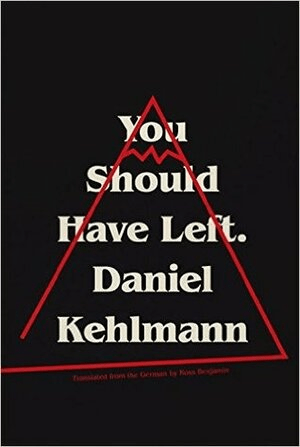
You Should Have Left by Daniel Kehlmann
My rating: four stars.
Short and sharp, this is the second Kehlmann I’ve read and it’s a long way away from the considered fictionalised biography present in The Director.
Instead, what we have is the diary of a screenwriter trying to write the follow-up to his successful work Besties, but not having a very good time of it.
On the face of it, things should be fine. I mean, he’s with his wife Susanna, his daughter Esther, and the trio are high in the Alps in what sounds to be a great Airbnb. I mean, until the nightmares about creepy women and appearing/disappearing photographs start turning up .
Write it down so that you remember, so that you can never claim it was only your imagination.
And true, it is odd that the locals – you know small-town locals amirite? – are rather drawn on who might’ve lived at the house before. Or what might have been there before.
As a portrait of someone fucking about when there’s actually work to be done, or of someone in a potentially collapsing relationship, this is a pretty good book. But when you tack on some clean air House of Leaves type moments, it becomes a great one.
It’s short. Go read it. Anything more here will spoil it. And I want to see if you were as unsettled as I was.
Confessions of an Economic Hitman by John Perkins.
My rating: three stars.
This was an odious little read.
In it, John Perkins tells the story of a so-called economic hitman (or EHM, if we want to be snazzy about it), essentially a consultant for large infrastructure development or consulting firm. The goal of the EHM is to promote the spread of American influence across underdeveloped countries in a form of economic colonialisation under which the countries are beholden to the US by financial ties they can’t effectively overcome without offering up easy political and natural resource access.
The United States spends over $87 billion conducting a war in Iraq while the United Nations estimates that for less than half that amount we could provide clean water, adequate diets, sanitations services and basic education to every person on the planet. And we wonder why terrorists attack us.
The firms – think Bechtel, Halliburton or KBR for a sense of scale – are not displayed in a pleasant manner, and nor are those who press the flesh in various foreign climes. Perkins spends the book essentially warning against the job he claims he was tapped by the NSA for, which is relatively admirable. But the narration comes across very much as some kind of Orientalist-style puffery: the white man from the States heads out with some friendly locals in order to have a Moment of Revelation courtesy of a down-to-earth Person of the People and decides to take a straighter path.
Of course, he keeps on going about his EHM business. And it happens again. And finally he gives it up and starts to work things out but at this point it’s a bit like being stuck in a recursive Scar Tissue loop with Anthony Kiedis going on about getting on smack, getting off smack, meeting an angel made human, showing you a picture of their breasts and then going back on smack again.
But with infrastructure.
(For what it’s worth, this is not the expanded version of the book. Not sure if that would make it better or worse? But it’s worth noting that Perkins’ relationship with the truth, while broadly fine, has been reported as being a bit touch-and-go where specifics are concerned. Maybe take his words with a desalination plant or something.)
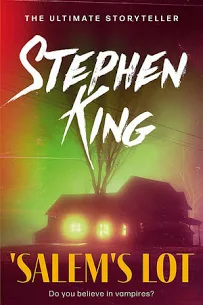
‘Salem’s Lot by Stephen King.
My rating: four stars.
I have, throughout my life, had a number of copies of this book. I’ve been meaning to read it for decades and I can’t think why I hadn’t tackled it, other than because the leading apostrophe gives me an inexplicable ick. (Inexickable?)
Anyway, travelling home from a two-city business trip I figured it was time to crack out the ebook edition: King is perhaps the perfect airport lit, after all, propulsive and moreish.
I’m not sure what I expected, but I was pleasantly surprised. This was his second published novel (after Carrie) and it’s his take on Dracula, though he only uses Bram Stoker’s epistolary approach as seasoning rather than the main event. The novel tells the story of a small town in Maine, Jerusalem’s Lot, where a novelist named Ben Mears has returned after a quarter of a century.
These are the town’s secrets, and some will later be known and some will never be known. The town keeps them all with the ultimate poker face. The town cares for devil’s work no more than it cares for God’s or man’s. It knew darkness. And darkness was enough.
Turns out (and this is no spoiler because fuck me, the book is older than I am) that some of the town’s blow-ins are of the bloodsucking kind, replete with Bela Lugosi hairdos and compelling gazes. Hilarity does not ensue, but the horror is conveyed with a finely honed sense of smalltown portraiture. I read somewhere that this was the book that set the template for the popular horror book: something grotesque crossed with Peyton Place and it fits pretty well.
The novel is certainly the writing of a young man, and there’s elements that don’t gel or that read as if they sounded better in the author’s head. But for a fifty-one-year-old I still inhaled it fairly breathlessly. True, I wasn’t as chilled as I get when I reread The Shining (even now), but this hit the spot and reminded me that I’ve got to read more King, because it hits the spot pretty much every time.
Let’s see if the next lot of reviews take a) as long and b) are as numerous. Hopefully addressing a) will take care of b) but given how work’s going this year (tldr: hectic as fuck) that could be a bit of a foolish undertaking to commit to.
Still, onwards .
If you’re after some good bookish times, please check out my profile on TheStoryGraph.
If you’d like to buy me some books to review, there’s a wishlist over here.
 Yeah nah.