In a change to my normal way of doing things, I’m planning the pages for 2026 on New Year’s Eve. This is because I won’t get to do my usual year-end write-up until next year, and I figured I wanted to have my motivational, a-nice-lot-of-books-to-choose-from list done before the next year and its horrors arrives.
Anyway, here’s a list of books.
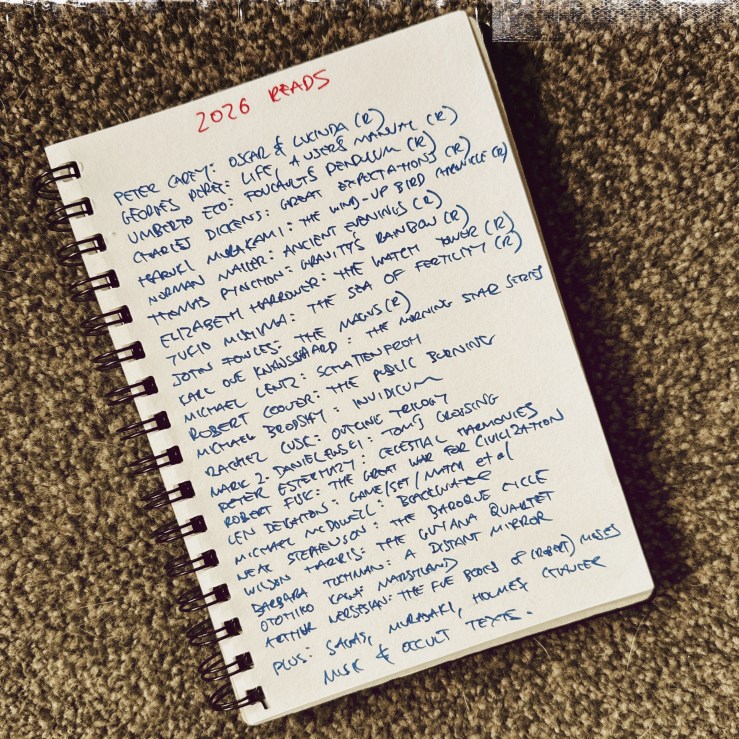
As ever, the main list is equal to the number of years through the century we are. So there’s 26 books chosen for 2026. This selection has a bit of an extra rule happening, though: there’s ten books on it that I want to reread because they’re books that had an impact on me while I was growing up. Some of them I haven’t read for 30 years. But I figured that if ever there was a time for looking back, 2026 is it: I’ll be turning 50, and so taking stock of books that have contributed to me (and potentially confirming my suspicions of high cringe value for some entries) seems to be the go.
The other guiding light for this list? Chonk. Heft. MORE WEIGHT. I want to read some longer, beefier books over the next year to really immerse myself in some worlds. Sort of like a whiteboy marinade, I’ll be luxuriating in some truly insufferable bricks and am hoping I’ll be all the better for it.
- Peter Carey: Oscar and Lucinda (reread): Something I read at school that stuck with me. I revisit it every few years, and though I suspect Illywhacker might be a better book, it’s a solid favourite (and, curiously, my gateway to liking Patrick White).
- Georges Perec: Life: A User’s Manual (reread): My first real encounter with playfulness in a book. Understandable, given Perec’s whole deal (writing books in French without the letter e being used, or as here, presenting the inhabitants of an apartment building in portraiture that follows a sequence derived from chess moves), I think I was too young when I read this so I didn’t appreciate it as much as I am hoping I will this time around.
- Umberto Eco: Foucault’s Pendulum (reread): In my more callow years I’d call The Da Vinci Code “Umberto Eco for Dummies” because I thought it made me sound funny. Really, it just showed I was a bit of a dick, and though I have no particular love for Dan Brown, I do now appreciate letting people read what they want, especially if it’s airport escapism. Anyway, I don’t remember much about this other than being struck by How Smart It Was (or how much I didn’t understand inside it), and I’m hoping it’s as much fun again. Also, one day I’ll get to see the bloody thing in Paris.
- Charles Dickens: Great Expectations (reread): I put off reading Dickens for ages, despite being told A Tale of Two Cities was excellent for years. (I finally read it recently and yes, it was.) But this was my first holy shit moment with the author: I read this the night before an essay was due in year 11 or 12, and found myself engrossed, which as fellow last-minute essay writers will acknowledge, is Not A Thing That Happens Much. Like a comfy pair of slippers, this.
- Haruki Murakami: The Wind-Up Bird Chronicle (reread): I bought this on release and read it in summer, not really understanding it too much, but enjoying the strangeness. I’m not entirely convinced it’ll with stand the reread intact, but I haven’t given it a look since, and would like to revisit the roots of my youthful Murakami stan mindset.
- Norman Mailer: Ancient Evenings (reread): Another that might not survive the resurrection? It remains the only Mailer I’ve read, and while I always intend to get around to others, this intensely queer Egyptian tale seems to be the one that sticks.
- Thomas Pynchon: Gravity’s Rainbow (reread): You knew this would be here, and it’s only because I’ve reread The Crying of Lot 49 too recently for it to get a nomination here. This one blew my socks off, and I am absolutely certain that I don’t get even half of it. But as Tom Waits says, the obsession’s in the chasing and not the apprehending.
- Elizabeth Harrower: The Watch Tower (reread): While two biographies of Harrower have recently come out (and both are flawed, at least if the reviews are to be believed), this was one of the first Text Classics entries I read that made me think hang on, maybe there’s something to this OzLit caper. The fact Harrower wrote such incredible work and then just… stopped?… gives this even more pull.
- Yukio Mishima: The Sea of Fertility series (reread): My Japanese literature jag peaked when I was playing taiko – to the extent of competing in a Tokyo competition in the early 2010s – and Mishima is undeniably one of the problematic greats in that nation’s literature. I was too much in my own head when I read this, so would like to see what it’s like from a bit more clear-eyed view. Even so, there’s set pieces in here that I can still recall, so striking were they.
- John Fowles: The Magus (reread): Another probably flawed but remarkably impressive work, at least to the younger me that first encountered it. Not as compact and horrifying as The Collector (which is just about due a reread as well), the book’s sense of slippery reality has stuck with me for decades .
- Karl Ove Knausgård: Morning Star series: Being contrary, I’ve decided to avoid the series Knausgård is known for and go with this still-being-translated series. Crowley references and autofiction and a sense of occult time? Sure, let’s have at it.
- Michael Lentz: Schattenfroh: This is billed largely as bleak and confusing. That, plus the fact you could beat someone to death with the thing, is more than enough reason (for me) to read it.
- Robert Coover: The Public Burning: A repeat entry. Coover is someone I hear spoken of on par with Pynchon in terms of transforming one’s take on literature. Hopefully this year is the year that I get into this whole Nixon-baiting jam.
- Michael Brodsky: Invidicum: Another wanky novel that can be used for self-defence. A satire about experimental drugs that stretches over about 1200 pages? It’s singing my song.
- Rachel Cusk: Outline trilogy: Cusk is someone I know of but know nothing about, which is a failure on my part, given the positive reviews I’ve heard from people I trust. Let’s rectify that .
- Leo Tolstoy: Anna Karenina: A substantial Russian work I’ve not read, and am looking forward to, especially as I’ll be doing it as a buddy read with Elizabeth. Looking forward to being relentlessly bummed out by this one.
- Mark Z. Danielewski: Tom’s Crossing: Hoping there’s less QuarkXPress fuckery in this extensive cowboy tale.
- Peter Esterhazy: Celestial Harmonies: An intertextual Hungarian history that refers to all men by the same term? Sure, that won’t be confusing AND OF COURSE I AM HERE FOR IT.
- Robert Fisk: The Great War for Civilisation: Another one I’ll be buddy reading. I’ve had a copy on my shelves for a long time, and given my recent reading on CIA fuckery, I figure it’s time.
- Len Deighton: Game, Set & Match; Hook, Line & Sinker; Faith, Hope & Charity: Airport defragging for my brain, still suitably hefty but goes down like popcorn. Figure I might as well do these in a row.
- Michael McDowell: Blackwater: The other McDowell I’ve read was delightfully creepy, so I reckon it’s worth tackling this, his largest work.
- Neal Stephenson: The Baroque Cycle: Tried before, couldn’t get into the first book. In theory I enjoy Stephenson, though it’s very much [Smart] Dudes Rock! Written by Dudes! – this time around maybe it’ll click. The setting is like catnip to me, so I’m still unsure why I’ve not burned through yet.
- Wilson Harris: The Guyana Quartet: Difficult Caribbean literature that eschews simple plot and speaks to identity.
- Barbara Tuchman: A Distant Mirror: The history classic I’ve yet to read.
- Otohiko Kaga: Marshland: another one up from previous years. Something about Tolstoy-but-Japanese is sticking with me.
- Arthur Nersesian: The Five Books of (Robert) Moses: Another repeat entry. I’m hoping that now I’ve read Caro’s The Power Broker, there’ll be some bon mots I can snottily haw haw at in here.
The other things that’ll be on the go this year include: rebooting my reads of The Canterbury Tales, The Tale of Genji and all of the Sherlock Holmes stories. I’ll more than likely read one or two novels in the Expanse series, and intend to read some Norse epics and Icelandic literature as we’ll be travelling there later in the year.
About a week ago I was moving some bookshelves around to make some more room in my hoarder’s paradise of an office to put some guitars up on the wall. The active physical handling of shelves and shelves of books forced me to notice how many good ones I have.
I don’t say that in a bragging kind of way as in ‘Oh look I have some sort of Caxton manuscript here!’, but more in that Umberto Eco, library-as-a-universe-of-potential way.)
Every armload revealed titles that I thought I should read, and that I felt bummed about not having read yet. It inspired me to want to read more things. And I realise that I have a lot of things that I could read right here. So for 2026 I have decided to try and tamp down on my book purchasing. I know this is heresy in terms of the book collector in me, but I have so many things that deserve to be read and I’m keen to read them. So I have put rules around my purchasing habits for the next year. (These do not apply to people buying me books, which I encourage you to do, with inspiration here if you fancy.)
I can only buy books under the following circumstances:
- If I am on holiday (within reason).
- If it is a book I have already pre-ordered in 2025.
- If it is the next book in a series I have already started reading.
- If I’m using a gift card I’ve been given.
(Additionally, I can only bring home a book from a street library if I put TWO books into the same library.)
I figure these are rules that will help me. I know that I fall into a trap of buying ebooks all the time that just get added onto a to-be-read pile that I don’t even see. At least with physical books I can see I have walls of them ready to crush me in some sort of a weird binding-related accident.
Let’s see how that goes.
 Yeah nah.