There’s been another five books read! So that means I’ve scraped some thoughts out of my cranium and finally turned them into a post – I’m not kidding when I say this has sat in draft form for about ten days – for your delectation.
Right. Here we go.
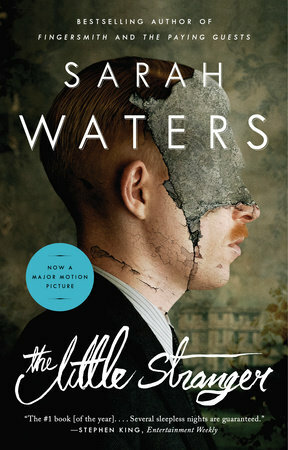
The Little Stranger by Sarah Waters.
My rating: five stars.
This is my first Sarah Waters book, and it’s not one of her self-described Victorian lesbian romps. Rather, it’s a gothic horror set in the post-war, pre-NHS England of creeping socialism, military PTSD and crumbling stately homes.
For the most part, the story that’s told is one of ghosts, of the mysteries that attach to a location. There’s a large element of psychogeography to the text, the concept that the things done in a space echo through time (which, as you can imagine, I am very here for). But it’s also a piece of social critique, an examination of class (particularly the working class as it attempts to make its way into the upper echelons of society) and of loss – the loss of a child, or a future, or past riches.
It seemed that all my business with the Ayreses just now lay either in warning them of something or in carrying out some dreary undertaking on their behalf.
The story is told mostly from the viewpoint of Doctor Faraday, who as a young boy had a fascination with Hundreds Hall, the decomposing mansion at the heart of the drama. He becomes enmeshed with the down-on-their-uppers Ayerses, a family burdened by finance, dead children, battle scars and their own history.
Bad things begin to happen, but it’s difficult to put one’s finger on what is happening. There’s the drive of Faraday to put a scientific spin on everything, to find a precise physical reason for events that seem to have their root in the supernatural.
But I slept badly; and while I lay tussling with dark, violent dreams, something dreadful happened out at Hundreds Hall.
There’s a malevolence in the air, and it’s infectious: the question is whether Faraday is able to corral it, or even understand it. There’s a delightfully uncertain feeling about the story (that holds beyond its conclusion) that I found particularly appealing, particularly given the waves of social change one can feel lapping at the edge of the pages.
After I read The Little Stranger I sought out the 2018 film version.
It’s the kind of film that if I’d seen it before I’d read the book, I’d think it was great. As I saw it after I’d read the book, it was just an okay adaptation. They change enough of the book – particularly some of the more ambiguous parts – to make it more workable as a straight narrative. There’s a certain element of telescoping at work, though the biggest strainer of credibility was the idea that we were supposed to believe that Ruth Wilson is plain. Other than that, though, it’s a nicely quiet film of lurking suspense.
The book’s the thing, though.
(There’s a good interview with the author about the film here.)

Panthers and the Museum of Fire by Jen Craig.
My rating: four stars.
This is the sort of book – as Craig herself admits within its pages – with a title that automatically makes you wish you’d thought of it yourself. It’s good.
Of course, this probably makes fuck-all sense to people not from Sydney. For ages, there used to be a brown road sign indicating that, just off the motorway, the weary driver could visit Panthers (a little bit of Vegas sports club in the heart of Penrith) and The Museum of Fire, a museum (unsurprisingly) dedicated to both fire and fire engines. It’s one of those signs freighted with a sense of mystery. What are these places? Why are they worthy of a brown sign?

Such is the pull of the mystery of both that I’ve never been to either. I don’t want to spoil the magic of the phrase with something as tawdry as actual experience.
The same applies to the narrator of this fictionalised memoir, Jen Craig. The narrative describes her walking from Sydney’s Glebe towards the city, looking to meet up with the sister of a deceased friend. This sister, Sarah, had foisted a manuscript – Panthers and the Museum of Fire – onto Jen at a wake, demanding she read it, but has had second thoughts, and now wants it back. What we get are Jen’s thoughts as she walks along Sydney’s arteries .
Sarah called me Jenny, of course, which nobody but my parents call me these days – my parents preferring to ignore the fact that they had called their daughter after, though in advance of, a multinational dieting company
We are told the story of the funeral, of the friend’s secret writing, and increasingly, of Jen’s desire to fit in. Pledges with god, the predictable solace of an eating disorder, and the feeling of galactic-distance loneliness in the midst of a group are examined as the strolling continues.
They were the rich and witty ones. We were the poor and bereft of anything to say.
It’s short, but it covers a lot of ground, and there’s the feeling that these are just thoughts unspooling: the walking is the frame upon which the reflection hangs, and it just works. It’s also home to perhaps the harshest incidence of being seen that I’ve experienced in recent reading. I mean:
I have always wanted to write novels – more than anything else in this life I have wanted to write novels that I could hold in my hand – and yet I haven’t had the perseverance to get anywhere near this achievement; all the words that I intend to write evaporate as soon as I think of them, and when I look back on my life, all I see are these words I have intended to write: all the thousands and millions of words I would like to have put down on paper (or if not on paper, onto the luminous, uncaring face of a screen).
Savage.
What Jen Craig has created in this book is something remarkable. The narrator is prickly and unlikeable, and doesn’t care if you don’t like her. The story appears obliquely, and there’s a feeling that one doesn’t ever really have a handle on what’s going on. But I was entranced the whole way through, and honestly in awe at how real everything here felt. There are things described here that I haven’t directly experienced in my life, but they ring true.
If you’re interested in books that do something different under the guise of normalcy, this is absolutely worth your time. I’ve already bought some of Craig’s other books, and will be keen to see how they compare.

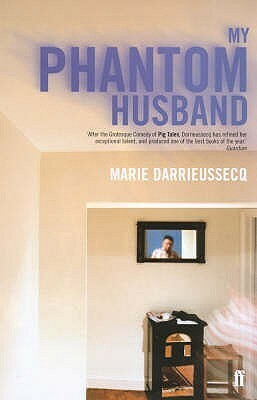
My Phantom Husband by Marie Darrieussecq.
My rating: two stars.
What happens when your husband comes home, realises you need some bread, and then goes out and is never seen again? How would you deal with it?
(I mean, assuming this isn’t a fervently wished-for occurrence in your domicile. If it is, may you always need another loaf.)
What happens in My Phantom Husband is that the limits of the world one once knew become fuzzy, permeable. Once solid truths and routines dissolve and there’s a sense that one has fallen into a dream-state, or a land that’s exactly like normality, except everything’s just a little bit off.
I wanted to believe that my husband still shared the same space as me, that we were still two fish in the same sea, that it would take only a reasonably well-organized fishing trip on someone’s part before we found ourselves back together in the same net.
I just didn’t get into the groove with this book. it began in a way that compelled me, and the panic of loss (and the gradual adjustment to the new status quo) was conveyed really well. It all felt very French in that sort of listless, exhausted way. But then there was mention of another alien civilisation living next door to the book’s characters, with no explanation. I was mystified, and it wasn’t until I did a bit of post-read googling that I discovered that Darrieussecq’s earlier writing features a race of extraterrestrials.
It seems that knowledge that might’ve been key to enjoying things. As it stands, I didn’t. It wasn’t terrible, but I’m very much about avoiding meh if I can. There’s too much good stuff to read to be hamstrung by meh.

Potiki by Patricia Grace.
My rating: three stars.
I was living in New Zealand when this book won the national book award for fiction. I was, however, 12. So it wasn’t on my radar at the time: I think I was still in a big Ian Fleming and Steven King hole at the time. But my time in Aotearoa left me with an interest in Māori culture – I remember being powerfully struck by the Te Maori exhibition in Auckland, and seeing the wakas carved by young people come up to a bay, all incredible woodwork and energy – that hasn’t abated. It was the first time I was prompted to actually think about a country’s pre-colonisation peoples, and how colonisation still affects them.
(This is an area I’m still really working on understanding and being better an allay for. Given that I live on someone else’s country – Wiradjuri land – it’s the fucking bare minimum.)
Anyway, I don’t want to get deep in the weeks, but rather note that when I was 12, both NZ literature and the finer points of colonial discourse escaped me. Now, I’ve a little better a handle on them, and so I finally real Potiki, a brief novel about a community and about how community flexes when confronted with obstacles: developers, particularly.
Though Grace has said the book is meant to be a portrait of ordinary life, there’s a strain of the political running through it. It’s hard not to see it: the incursions into the community’s land, the disrespect for graves and established structures are the country’s history in a smaller scale.
The novel is told from a number of viewpoints, and the community is really fleshed out without being described. The cross-hatching that comes from different characters’ takes on events offers cues to what’s going on, and there’s a sense (for me, at least) of having to try to catch up with what’s happening, even though the story is relatively simple.
(Well, except for the Christ figure.)
Another aspect of the novel that was a challenge for me was the extent of te reo Māori in the text. I’d picked up a tiny amount, and some of the words I knew were in here, but there was a lot I didn’t. Grace has copped criticism for not including a glossary in the work, the logic for exclusion:
I’d had a glossary in a previous work and then I suddenly thought that a glossary is there for foreign languages, italics are there for foreign languages. I didn’t want Māori to be treated as a foreign language in its own country.
…seems pretty straightforward to me.
I feel there was probably a lot of nuance in this book that I didn’t get, for purely cultural reasons. Still, I enjoyed figuring what was happening, and particularly in the representation of parts of small-town NZ in the ’80s. I’d like to read more Māori literature, so I will definitely explore Grace’s work, and see where else the trail leads.

The Good Wife of Bath: a (Mostly) True Story by Karen Brooks.
My rating: four stars.
For the HSC, I read the pieces of Chaucer’s The Canterbury Tales which feature The Wife of Bath, arguably one of the most developed characters in the collection. I largely remember those lessons being filled with discomfort as our elderly English teacher (Mrs Murphy) kept casting around the room to try and get a teenager to describe what a queynte was.
Anyway, I haven’t read any Chaucer since, but I recall very much enjoying the fact that, in the Tale, the titular Wife gives absolutely no fucks about anything except fucking. And convincing the reader that they’re wrong about women. She’s an early feminist icon, unrepentant about her desires, and funny as hell.
Was I cold? Satan’s tits, I was colder than a duck’s arse in December, but I basked in the warmth of folks’ approval.
Karen Brooks’ novel aims to tell the story of the Wife of Bath from her viewpoint, and it succeeds admirably. What’s presented is a narrative that’s woven from Chaucer’s text – his biography, too – and historical fact. Everything that’s in the book regarding dress, punishments and the minutiae of running farms and families in the period springs from an extensive collection of referenced resources.
What we get is an historically accurate story of a woman who likes to fuck, dislikes fools, and grows up fast. She’s related to Chaucer – who has input on her first marriage, at 12 years of age – and we spend a lot of time inside her head as she bucks against the form and diminished space society demands she occupy.
The narrative follows the story unfolded in Chaucer’s text, but there’s more depth. She’s not just a mouthpiece for thoughts about women, as her creator would have her. In Brooks’ charge, she’s a fully-formed person who effects her creator, spurring Chaucer’s presentation of her in his writing.
The relationship between Chaucer and the inspiration for his creation is a key part of the book’s structure, but it is secondary to both portraiture and testimony to the value of relationships. The Wife in this book knows the strength necessary to survive in a world run by men stems from unity, from collaboration, from friendship and care. There’s a freedom described that is unusual, given the monies inherited from dead husbands, but it allows our lead character to poke whack at pilgrimages and people with aplomb.
On it went, for days – places where someone was beheaded, whipped, prayed, had a shit, lost a tooth (I made those up), said ‘Hello, did you miss me? I’m back’. We saw them all.
This is bawdy fun with depth. I had a blast. This went down like popcorn, and I’m interested in seeing if that’s true of Brooks’ other works.

(One of the books currently in progress is a copy of The Riverside Chaucer so I’m looking forward to reacquainting myself with the original text sooner rather than later. It’s been long enough.)
So that’s the next five done. I’m currently working through a brace of books (largely to defeat the feeling of weird ennui that’s settled in in the past couple of weeks) and am hoping to have made more of a dent very soon, so I can write up some more. Let’s see how that goes. It’s a plan, at least.
If you’re after some good bookish times, please check out my profile on TheStoryGraph.
If you’d like to buy me some books to review, there’s a wishlist over here.
 Yeah nah.
[…] reading Karen Brooks’ The Good Wife of Bath I figured I should check out the real life of Geoffrey Chaucer to see how it stacked up with the […]