
Returning from the Northern Hemisphere to home where a feels-like temperature of minus nine is more common than not? A bit of a rude awakening, I must admit.

What’s positive about this state of affairs, though, is that I have continued to plough through the books. There’s nothing better to do in winter than hunker down with text, and I’ve been enjoying it greatly. Even if I have to wear a beanie throughout.
The Magic Mountain by Thomas Mann.
My rating: four stars.
I’ll preface this by saying that I’ve no doubt that I’m too dumb for this book.
No, seriously. I understand that The Magic Mountain – a buddy read undertaken before Olga Tokarczuk’s The Empusium comes out later this year (it covers similar ground) – is a difficult work. I just feel that some of the nuance is a bit subtle for me. And, perhaps, buried in a morass of navel-gazing extemporisation.
This is not a brief work. It’s only about 700 pages in length (a mere stripling compared to some fantastic tomes!) but each page contributes to a larger meditation on the illness facing Europe as it heads towards the meat-grinder that would be the First World War.
What our age needs, what it demands, what it will create for itself, is—terror.
The book operates on several levels, the apprehension of which relies on how well acquainted the reader is with history, musicology, philosophy, fairy tale and myth, allegory and empire. There’s a lot that’s referred to but not explained (I’m thinking more in terms of ideas discussed rather than narrative events) and while I was able to pat myself on the back for understanding a lot of it, I’m pretty sure there’s at least one entry missed for each one I got.
There’s a constant sense of flux underpinning the narrative, which spends a lot of time in the same place (a sanatorium for respiratory diseases) while a hapless youth (who was only meant to be visiting!) experiences a rest cure, attempts to find love, and generally is revealed to be a bit of a fool, destined to be tested in the crucible of history. During the writing of the work, Mann went from opposing the Weimar Republic to supporting it, so I suppose it’s natural that a fundamental change in authorial identity might ripple its uncertainty into the work.
As I say, I don’t know that I understand everything in here. I don’t understand all the allegory or symbolism in a lot of painting, either. But, as with an epic canvas, I appreciate the skill on display here, the tightly-packed shell of a thing that Mann has created. The ending shocked me out of the torpor induced by the restful eyrie of the book’s bulk, and I cannot but applaud how the author’s exploration of so many avenues ultimately leads to one terrible conclusion, for the story’s characters and for Europe altogether.
Don’t you love to look at coffins? I’ve always enjoyed looking at one now and then. I think of a coffin as an absolutely lovely piece of furniture, even when it’s empty, and if there’s someone lying in it, it’s really quite sublime in my eyes.
Iran: A Modern History by Abbas Amanat (read by Derek Perkins).
My rating: five stars.
In terms of histories of Iran, Amanat’s take on centuries of culture, development, trade and belligerence is going to take some beating, both for its depth and its sheer length. In book form it’s about a thousand pages, while the audiobook version (which I consumed on several drives to and from Sydney, as well as rounds of my property on the mower) is almost 45 hours long.
This is unsurprising, as if there’s one thing Iran has in abundance, it’s history.
I don’t know how best to review this work as it is so enormous (when compared to the piddling amount of time the nation of Australia has existed) in span and in sheer numbers of participants that the scale is pretty hard to get a handle on. It did feel as if the most recent decades were given relatively short shrift, but that’s probably unavoidable given the centuries the whole story covers.
Amanat’s prose is very easily comprehended and makes complex political and religious stoushes seem fairly straightforward. He tends to use “florescence” like it’s salt, and there is an element of repetition between the end of some chapters and the beginning of following chapters (almost as if parts had been written and then not revised when the preceding bit was finally worked out) but that’s a minor quibble: this is a very approachable (yet detailed) history that lets someone like me finally get a bit of a grip on the history of a land that has been pretty unknown to me beyond headline polemics.


The Haar, Satan’s Burnouts Must Die! and Dead Girl Blues by David Sodergren.
My rating: four stars, three stars and four stars.
After two fairly sizeable books I figured I needed a bit of mental defragging. Something that would entertain without requiring a huge amount of brain-revs. Something popcorn. Something horrific?
Something horrific.
I’d read some David Sodergren books before and found them immensely entertaining. His writing tends towards the more psychotronic end of the spectrum, with a bit of wry humour. It’s not cheese on a Troma level, but distinctly Scottish: the sort of taking-the-piss-out-of-blow-ins approach that comes from being hard enough to survive the weather up north.
(That and the wild Haggis attacks.)
Like Pringles (or crack) I discovered that once I started reading some more of his work, I couldn’t stop – not until I’d finished three, at any rate.
First up I tackled The Haar, which is the story of a sea monster, a diminishing community and a suspiciously Trumpian golf course developer set in the same neck of Scotland as Sodergren’s Maggie’s Grave. I enjoy the feeling I get when a horror author has their own patch (hello, Castle Rock) and knowing this sea monster tale took place somewhere I’d visited before set things off well, though not as well as this opening:
Muriel Margaret McAuley was eighty-four years old the first time she saw a man turned inside-out by a sea monster. You might think it would bother a woman of her age, but, as Muriel was fond of saying, she had seen a lot in her eighty-four short years.
That is what I’m talking about. The story was gross and surprisingly touching in its meditations on love, aging and the hard lives of those who pull their living from the sea.
(And on people being pulled inside-out by a sea monster.)
Subtlety was not on display during Satan’s Burnouts Must Die!, a short and sharp piece about, well, Satanic bikers invading the small US town of Dennyville in 1972. Part Easy Rider and part Manson Family frolics, it’s an investigation of how military rigour reacts to devil-fuelled excess, coupled with a neat Final Girl tale.
“Excellent,” said Marduk. “Pinky has chosen Gimme Shelter. We shall dance til sunrise in praise of our Lord Satan!”
It felt a bit more formulaic than the other novels in this brace, but in a distinctly grindhouse way: between the chases, the raging about how cool Satan is and a bit of accentuated violence, it zooms on to its conclusion while laying enough groundwork for the sequels Sodergren says are coming.
Finally, Dead Girl Blues was (as the yellow cover might indicate) a tribute to the world of the giallo. Willow, a young woman, is drawn into a world of mystery, murder and snuff films.
This fucker was so seedy she could plant him in a field and grow a crop of arseholes.
The story takes place in a far more grittily urban setting than Sodergren’s other works, spanning middle class comfort and the seediness of certain strip clubs. It features all the tropes you’d find in an Argento film, including ridiculous names (Vinnie Sunset!) and a remorseless killer. There’s the sense of networks closing in, as well as some seriously disconcerting instances of violence, as you’d expect for a novel plunging into the world of recorded-for-kicks death. This was certainly the most discomforting read of the three, and without the light touch of the author’s humour, the balance would’ve been altogether too much on the grim side of things.
Refreshing, though.
Sodergren’s books are only a couple of bucks in ebook format, and are absolutely worth your time if you’re even remotely interested in the horror or thriller genres. They’re over the top, they do what they say on the tin, and they’re put together with care. I’m a fan, and am looking forward to seeing what he comes up with next. (No doubt it’ll be gross, and I’ll laugh at it somehow.)
The Mezzanine by Nicholson Baker.
My rating: five stars.
Here’s one I picked up during the trip. It’s something I’d heard about for years, but hadn’t been able to find locally, so a stroll along Charing Cross Road soon had me fixed up. It’s Nicholson Baker’s first work, and involves the thoughts of a man returning from lunch.
That’s it. That’s all there is. And it’s wonderful. It’s a peephole in the brain of a cube-farm worker, a man whose shoelaces need replacing and who ponders the construction of milk cartons. A man who thinks about why people say “oop!” when they enter a bathroom at the same time as someone is leaving and have to shuffle past awkwardly. A man who meaningfully contemplates the physics of paper straws versus those of their plastic replacements. A man with a whole lot of ephemera on his mind.
Perforation! Shout it out! The deliberate punctuated weakening of paper and cardboard so that it will tear along an intended path, leaving a row of fine-haired pills or tuftlets on each new edge! It is a staggering conception, showing an age-transforming feel for the unique properties of pulped wood fiber.
This is a book people will either love or hate, and I loved it because it is underpinned by the idea that it’s minutiae that makes up the world. This, rather than Seinfeld, is a cultural creation about nothing, as it unpicks all of the tiny nothings we might think about during a small slice of the day (an escalator ride to a mezzanine level) and shows how simultaneously important and disposable they are. It’s a slim and excellent tribute to the power of mundanity.
The feeling that you are stupider than you were is what finally interests you in the really complex subjects of life: in change, in experience, in the ways other people have adjusted to disappointment and narrowed ability. You realize that you are no prodigy, your shoulders relax, and you begin to look around you, seeing local color unrivaled by blue glows of algebra and abstraction.
I can’t wait to read more of Baker’s work. This was an absolute delight.
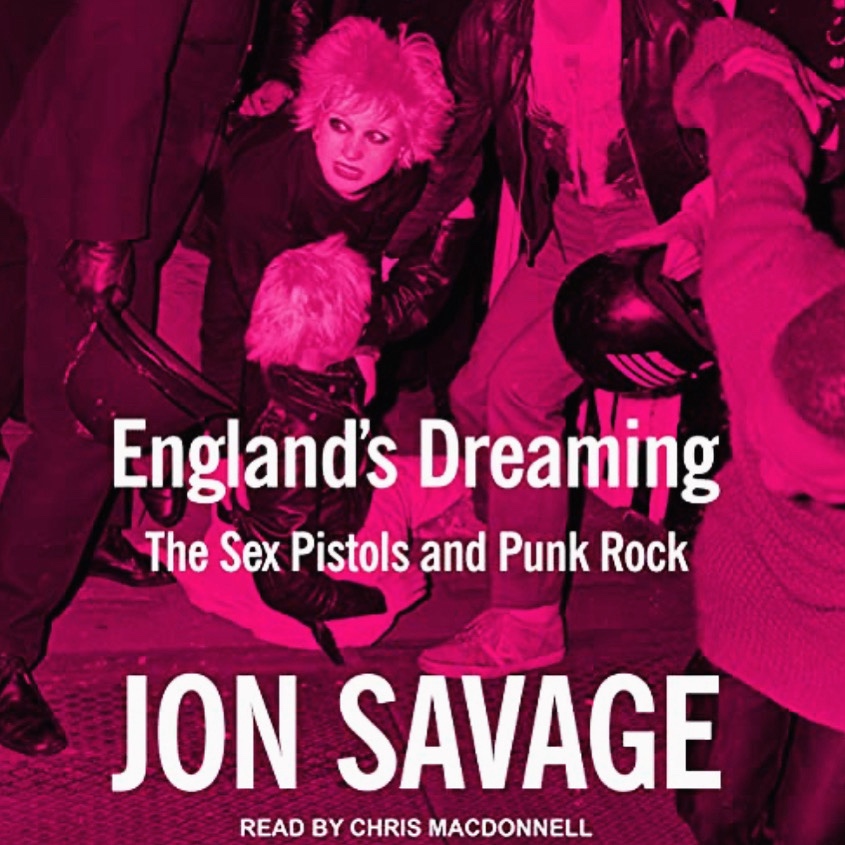
England’s Dreaming: Anarchy, Sex Pistols, Punk Rock and Beyond by Jon Savage (read by Chris MacDonald).
My rating: four stars.
Punk. Now, I know that we invented it (The Saints, anyone? Mark Arm would agree) but given that the genre was described through the lens of the UK music press, things that occurred over there – mostly in London – it’s undoubtedly more exciting to focus on what went on there than in Joh’s Brisbane.
*ahem*
Right, so I’ve never really had much of a grasp on the early days of UK punk, other than being of the belief that the Sex Pistols were a boy band assembled by Malcolm McLaren. I wasn’t really into Lydon et al (being much more of a fan of the early Cure’s style of nihilism) and I correctly figured that Savage’s well-regarded book would be a way to rectify the stunning gap in my musical knowledge.
The book is incredibly well written, and I appreciate the way that the author manages to make Malcolm McLaren seem even more punchable than I had believed possible. For someone who was such a prime mover in the scene (with Vivienne Westwood) I find it incredibly curious that the bloke wasn’t tarred and feathered on the reg. Despite his personal obnoxiousness, the portrait in here doesn’t chuck him solely in the evil mastermind side of the ledger, even though he was demonstrably a massive prick: instead, it shows how his obsessions and opportunistic nous were key in creating the visual touchstones of punk’s style. I hadn’t, for example, noted the influence of ’50s rock (which I really should’ve, given that I’ve read a bit of Nik Cohn!) on the nascent movement, nor of the importance of fashion to the movement, larded as it was with the reputation of being destroyers of civilisation.
I also hadn’t considered that the band were teenagers when they got together. That they were placed under incredibly scrutiny without the benefit of the sort of guardrails that stars of today even find difficult to put in place. The pressures on the unit were enormous, and I’m sure the effects were long-lasting. I began to reformulate my position early on in the book and it continued throughout.
Everything moves at pace, and I was amazed at how many people who later rose to stardom (Siouxsie, Adam Ant) merely traversed the beer-sodden carpet gap from audience to performer. The sense of community competition, of growing Thatcherite power, of roiling racism and of the endless pursuit of youth expression is ably conveyed, as is the corrosive impact of drugs – most notably on Sid Vicious and Nancy Spungen, but all throughout the scene. You’ll have a hangover from handling the work, I suspect.
Chris MacDonald’s narration of the audiobook is particularly suitable: he reads the stories of excess and opportunism with a vaguely unfussed voice that befits retelling an epic of the movement. He appears detached yet companionable, which proved (for me) an excellent combination.
I have to admit that anything that made me revisit the Sex Pistols with an open mind has some pretty persuasive power. I learned a lot from this book, and I’m very keen to check out some of Savage’s other work, particularly his most recent work on pop’s role in queer liberation.

Larrimah by Caroline Graham and Kylie Stevenson.
My rating: four stars.
So imagine a place in the middle of Australia’s Northern Territory. Fuck-all people live there, most of them are either recluses or completely mouthy, and life proceeds without much interruption from the outside world. Booze is drunk. Sun is avoided (because, as this is the NT, it’s shitfully fucking hot all the time) and the nearest supermarket is hours away. Tensions and feuds bubble away under the surface, the ability to enter the pub is a boon that’s given and taken, and generally there’s the vibe that this is a place for locals only. Buy your weird pie and fuck off.
That is, until a garrulous sprite of a man, Paddy, goes missing. It’s not in Paddy’s nature to just bugger off, so foul play is suspected, investigated and ultimately… well, ultimately nothing is particularly figured out.
Larrimah tells the story of the disappearance, the resulting inquest, and provides the sort of colour reporting that captures a portrait of a tiny town in crisis. It’s the sort of place (with a population only just in the double digits) at risk of receding into the dust. Graham and Stevenson do a great job of recording the decline of the burg, thumbnail sketching the inhabitants, and discussing elements of rural life – big trigger warnings for racism, sexual abuse and all the other niceties that accompany the history of First Nations peoples in Australia – that certainly don’t get enough air time generally.
Is the story solved at the end? No, but that’s not the point. The book allows you to luxuriate in the place for a couple of hours, to get a sense of a weirdly different way of life, and to realise that when some people reinvent themselves, their stories perhaps aren’t meant to have a neat ending.
It’s worth mentioning that there’s a two-part documentary (on Netflix and HBO) called Last Stop Larrimah that covers the mystery in some detail, and gives you a more immediate sense of the characters within it.
I actually read Larrimah after I’d seen this series, and I feel it was a good approach because it meant I had a better idea of the people the authors were writing about. The documentary contains more information about the disappearance that’s pretty shocking, but also does not cover nearly as much cultural context, which is probably understandable when you’ve got Fran in your face.
Both of these are recommended, and they pair nicely. Where the fuck are you, Paddy?
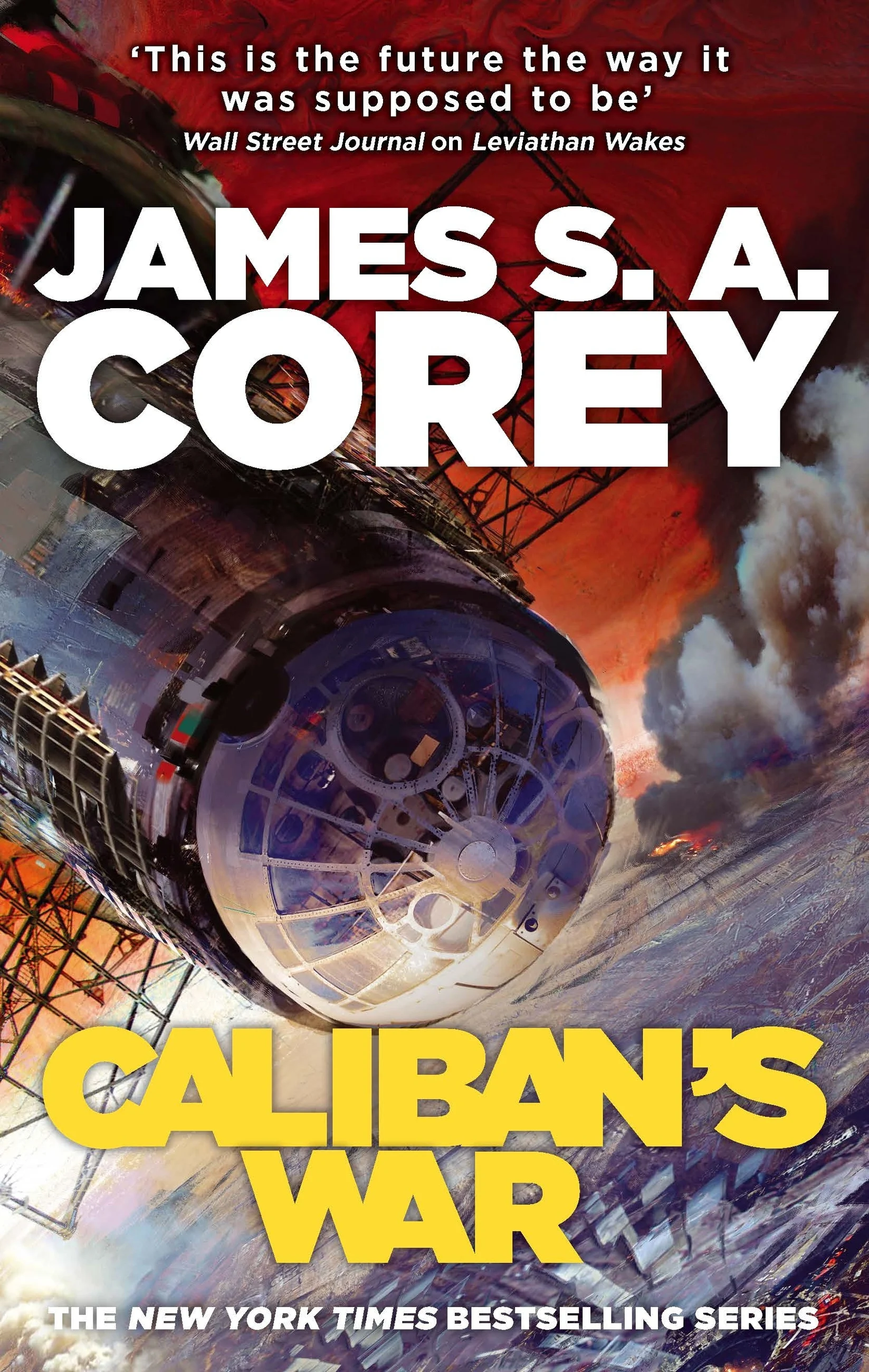
Caliban’s War by James S. A. Corey.
My rating: five stars.
Last year I read Leviathan Wakes, the first book in The Expanse series and really dug it. It was smart sci-fi that appealed to someone who’s not traditionally enjoyed SF/F all that much. (It seems I’m making up for lost time this year, however.)
Caliban’s War continues as the duo Corey (they’re two guys writing under one name) began: characters from the initial book reappear and we learn more about how their role in keeping contending universal stakeholders from destroying each other has progressed. Our gang of heroes are roped into a missing persons case – one that’s occurred in the aftermath of a vicious attack from a life form thought previously despatched.
Plan? My plan is to die in a ball of superheated plasma.
Tensions ratchet up and the novel – written in punchy chapters – flips between political machinations and beating informers with canned goods. The mixture of action and bitchery (there is a two-woman pairing – a Marine and a UN old hand – that absolutely rules) and corporate malfeasance (yes, really) is extremely well handled, and keeps the narrative from being too much of any one thing.
I have a binder with nine hundred pages of analysis and contingency plans for conflict with Mars, including fourteen different scenarios about what we do if they develop an unexpected new technology. The binder for what we do if something comes up from Venus? It’s three pages long, and it begins Step One: Find God.
While each of the entries in this series that I’ve read so far have had great self-contained stories, I do like that there’s the distinct feeling of a fully-formed universe outside these narrative. Larger tendrils of narrative are salted throughout. The benefit of me reading the series now that it is (I believe?) finished is that I know there’s a linear progression, and that it’ll build towards something bigger than each individual adventure. That’s exciting, but I am much more impressed with the minutiae in the books that proves the authors have given a lot of thought to making their worlds living, breathing spaces.
I’m really looking forward to the next one. I’m finding it difficult not to plough through the rest of the books immediately: I’d rather parcel out their serotonin deliveries so they last, though. You know, get a real sense of space and its vastness. And bitchiness.

Juice by Tim Winton.
My rating: five stars.
The first Winton I ever read was In the Winter Dark, inspired by the film adaptation. It didn’t make much of an impression (though to be fair I guess I was only about 20 at that point), but the next work of his I read, Cloudstreet, did Cause Feelings, largely because I read it while I was homesick, living in London.
I haven’t reread it yet, as I wonder if the spell of that read – and the theatrical adaptation that toured around the same time – would be broken.
I can’t say I’ve kept up with Winton’s output much in the decades since, as there’s a prevailing through that he tends to write the same thing repeatedly. Juice, his newest novel (available in October this year), seems to be something that might put paid to that idea that he only writes about surfing or dudes.
Dudes feature in this, still – I’m not sure we’ll ever get out of that neck of the woods – but the setting is an Australia of dystopian future. It’s far from the beach shacks or the recent past of his other works: in this one, our generation is to the book’s characters what the vikings are to us. We’re sagas, memories. The world has, thanks to climate woes of increasing severity, turned into a Mad Max-style place, where bands of survivors eke out a hardscrabble existence growing, trading, and trying not to be killed by nature.
You know, the usual.
The dude in this story, though (nameless) relates a tale of survival and of ethics, of working with the land and its people, and of the pressures and bondage of responsibility to family, work and culture. Of the need for juice, for energy in general, and for moxie or drive in particular. The narrative unspools as a life’s story told to a captor, attempting to pull a Scheherazade and save the life of both himself and the mysterious child in his care.
Winton’s writing definitely features a strong sense of country and of humankind’s interaction with it, and it’s not hard to see that in this timeline, what’s going on is both the logical conclusion and the just deserts of what we’re doing now. There’s elements of our existence seen from a distance, in a setting that’s sci-fi enough to build a world without info-dumping, in a way that might just turn people with no interest in SF/F into enthusiasts.
Juice surprised me. I went in, expecting it to be ho-hum, and found it to be a compelling, quick-reading piece of a sun-cooked future. I reckon this one will sell a bunch. (I mean, what of his doesn’t, but this seems refreshingly out of his usual wheelhouse.) Check it out if any of this vaguely appeals: I was impressed by how the novel crept up and snared me.
Right. This is altogether too many reviews in one go, both for me to write and for you to read. So I’ll attempt to get back on the five-only horse for next time. No promises, but hope springs eternal, right?
If you’re after some good bookish times, please check out my profile on TheStoryGraph.
If you’d like to buy me some books to review, there’s a wishlist over here.
 Yeah nah.
[…] Tim Winton’s Juice reminded me of this story of dystopian thirst. It’d been decades since I had read it, and I […]
[…] when I heard that this was the author’s version of Thomas Mann’s The Magic Mountain (which I read earlier this year in preparation) I was very […]